From the Editor: Keeping It Light
(This story originally featured in Wild #195, Autumn 2025)
With all the crap going on in the world at the moment, I thought I wanted to give myself a challenge for this issue’s letter: Write something funny. Something so light-hearted it would float off the page. Something that would serve as an antidote to the onslaught of depressing developments that seem to be hitting us in waves, kind of like when you’re out in the surf and a big set comes in, so that just as you come up for breath after being pummelled by one wave, another huge wave pounds in, forcing you to dive again, come up for a split-second of air, then dive again, and so on.
I don’t know whether I need to go into details of all the metaphorical ‘waves’ crashing in at the moment, but here’s a sample of the ones troubling me (I recognise that not everyone feels the same, and that one person’s wave might be another’s breath of fresh air): Inappropriate developments within national parks; climate change; the largely cynical state of Australian politics; housing costs; Gaza; President Musk and Vice President Trump; invasive weeds and feral pests in parks; rising inequality; native species on the brink of extinction; Parks Vic, and not merely because of the way they’ve managed the Arapiles’ climbing closures (see Ross Taylor’s piece on p46), but also the very dangerous precedents they’ve set by banning some off-track bushwalking and all scrambling in the Grampians; inflation; my mortgage; AI.
Yeah, AI’s a big one. Instead of investing in moving towards net-zero emissions, we’re planning to splurge literally trillions on a disruptive technology (one the general populace has never been asked if it actually wants), a technology that has every chance of delivering truly scary outcomes while doing nothing for—in fact potentially lessening—human happiness.
Wait a sec. Man, am I ever failing in keeping this ed’s letter lighthearted! This is pathetic! I’m gonna google around to see if I can find any outdoorsy jokes to lighten the mood. “Where do campers keep their money? In a river bank.” “I wasn’t so sure about abseiling … but then I was roped into it.” “Where do sheep like to camp? The Baa-hamas.” I ran this last one by my wife and my 11-year-old son; they both hated it.
Here’s another one: “Little Johnny goes camping for the first time with his dad. After they have set up camp, he asks where he can take a whizz. ‘That’s the beauty of being out bush,’ Dad answers, ‘You can go wherever you want.’ After five minutes, Johnny arrives back at the campfire. ‘So, where’d you go to the toilet, Johnny?’ Dad asks. ‘On your sleeping bag,’ Johnny replies.” My son laughed out loud when he read this one; I’m not even going to show it to my wife, though; I know she’ll just think less of me.
Perhaps I should just pivot to the outdoors, where we can at least unshackle ourselves from AI concerns. But then the other day I read about the Hypershell X, which went in mass production in January 2025, and which claims to be “The World’s First Outdoor Power Suit”. Essentially, it’s an exoskeleton that gets clamped to your legs to assist with walking. Now at first, I thought, “Wow, that’s potentially great for anyone with mobility issues.” I broke my neck a few years back, and having come face-to-face with quadriplegia, I know what a game changer this could be.
But then I looked at its website. The Hypershell X isn’t designed for people with mobility issues; it’s designed for everyday people who just, well, don’t want to do all the work themselves. Here are a few quotes from their website: “Combining state-of-the-art robotics, ergonomics, and AI into a compact form, Hypershell X enables you to go further and explore more.” “Boost your performance and reach your peak in any sport or activity.” “Let the Hypershell X extend your range with a 40% leg strength boost. Be free to challenge the jungles, deserts, and snowy mountains.” It prefaces that last statement with “Be truly immersed in nature.” Oh, the irony.
Now, one of the great things about the outdoors is that the effort required can act as a filter. It’s why even when you’re on a popular walk out bush, it’s still far less crowded than being in the city. And it’s why you can find a measure of solitude in difficult-to-reach places, or why when you’re, say, weeks into a wilderness walk or on the top of an alpine peak, you can be truly alone (although supplemental oxygen has changed the dynamic for the latter). I want these places to be fricken hard to get to—that’s the point. Even if I personally don’t have the skill, stamina, strength, endurance, willpower, time or commitment necessary to get there, I want these places to nonetheless exist. We owe it to those people who can get there. And we owe it to the creatures and plants that exist there to do so on their terms.
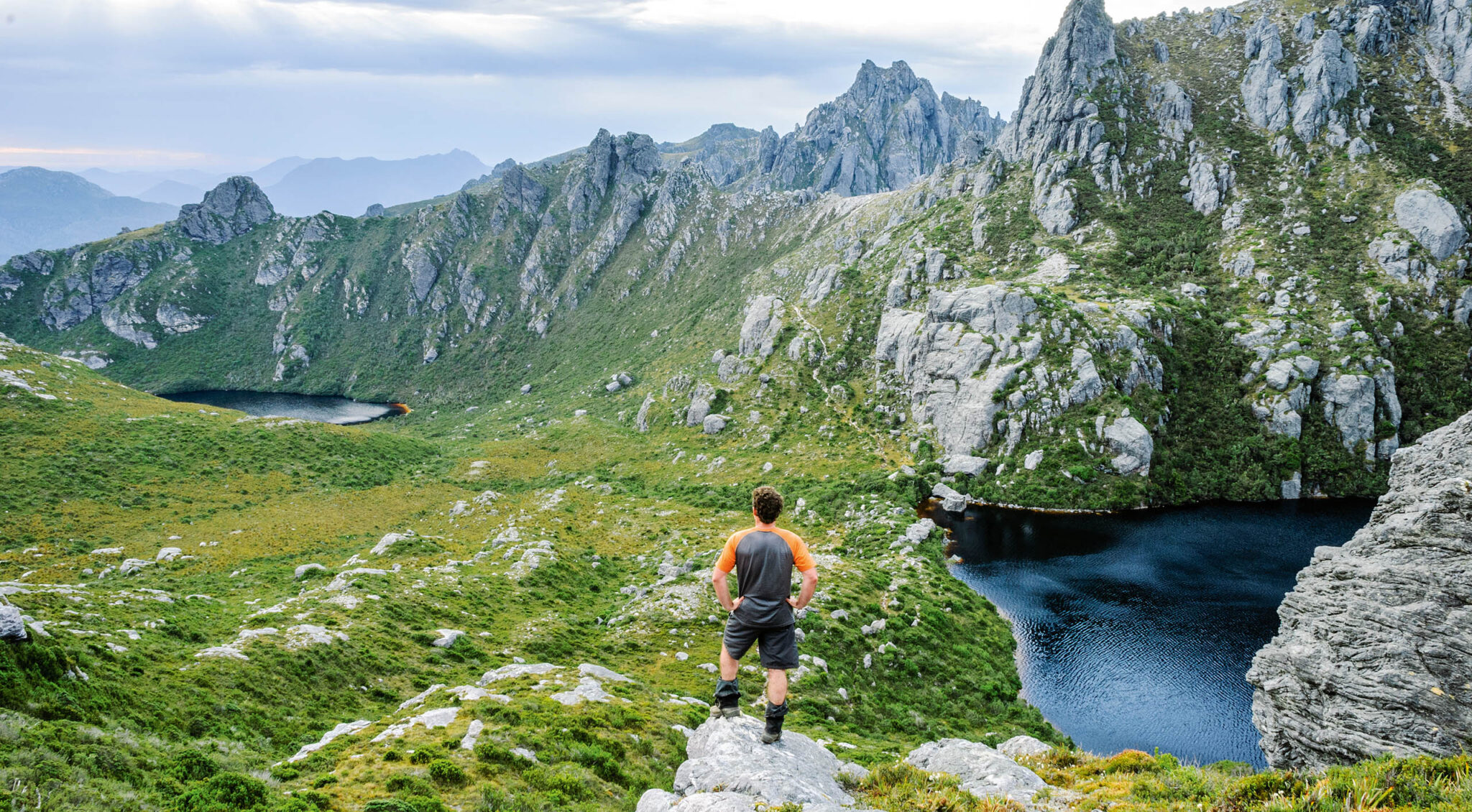
And then along comes the Hypershell X. Personally, I’m not convinced this is going to catch on, but I’m also aware this is only its first iteration; where will it be in twenty years? Will walking trails be overflowing because it now takes so little effort to walk or run them? Will Tassie’s Western Arthurs be swarmed by people knocking off the traverse in a day? Will you be able to go backcountry skiing without finding every slope tracked out by slews of people who’ve used AP (Artificial Physicality) for the skin up?
Damn it! I’ve done it … again. This isn’t funny at all. Let’s get back on track. “Why did the park ranger quit her job? Because it was too in-tents.”
If you liked this piece, you should subscribe to the print mag. Only a fraction of the great stories we run in the mag make it to our website; if you want to read them, head to subscribe.wild.com.au