From the Editor: Weighty Matters
(This letter originally featured in Wild #196, Winter 2025)
I’ve been thinking a lot about the past lately. And it’s Wild’s fault. Well, actually, it’s Dan Slater’s fault. Oh, and Adam Flower’s too. Dan, as you’ll read later in the issue, has written an excellent piece that delves into the philosophy of big trips. What defines one? How do they change you? And how do you even go about tackling one?
Anyway, since I’ve done a couple of big trips myself—a 53-day solo hike through the Japan Alps, taking in all ten of the country’s highest peaks, and, in my younger days, a 52-day solo hike through the Canadian Rockies, with that trip starting just days after a separate 13-day hike just north of the 52-day one; for all intensive purposes they were the same trip—Dan decided to interview me to hear my point of view. Now, I’m not going to spoil Dan’s thunder by telling you now everything I had to say, but I will say this: Both trips were absolutely pivotal in my life.
The Canadian Rockies one especially. Without a doubt, it’s one of the best things I’ve ever done. For more than thirty days on that 52-day solo trip, through the high mountains and open passes, through lush meadows and deep forests, I saw no one, except for bears, moose, porcupines, caribou, bighorn sheep, mountain goats, marmots and more. But here’s the thing (and this is actually getting closer, albeit marginally, to the point of what I want to talk about in this letter); I don’t feel like I travelled alone.
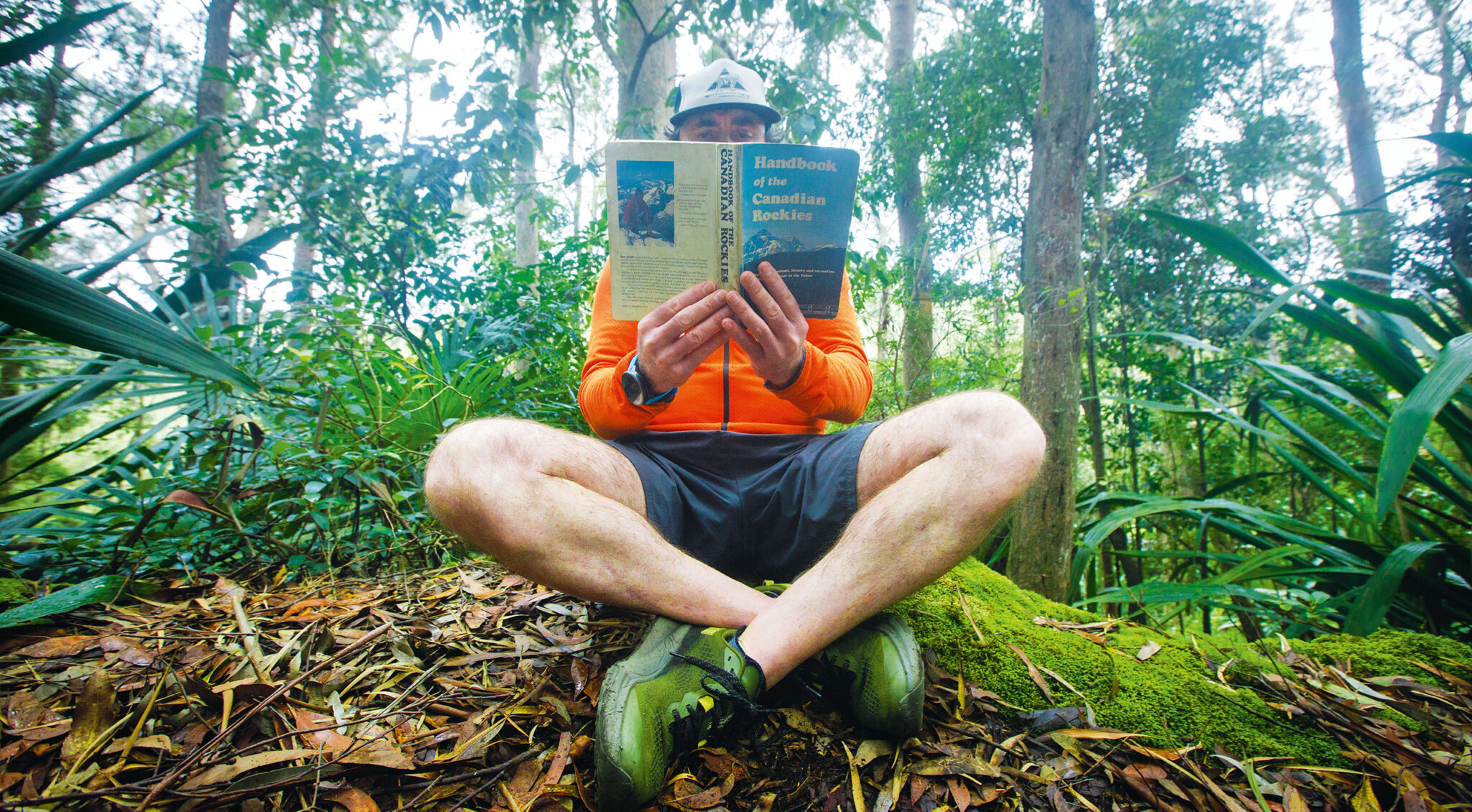
I was reminded of this, in part, upon seeing Adam Flower’s gallery image of the famed ice climber Will Gadd, because it was Will’s dad, Ben Gadd, who wrote a book I carried with me on that trip, a book that turned out to be one of the most important and most meaningful I’ve read in my life: Handbook of the Canadian Rockies. An all-encompassing field guide, astonishingly broad in its scope, the book covered geology, plants, animals, history, recreation and more, and it did so in incredible detail over nearly 900 pages (that’s not a typo) of teensy-small-font text and images.
I googled “hiking unnecessary weight”. The very first answer was a Reddit ultralight thread, and right near the top, third out of 192 comments, was “I saw a guy carrying three paperbacks on a hike …” Three paperbacks—that was me exactly, although mine were heavier than most.
Now, you would expect a book like this to have been turgidly dull, a mere recitation of facts and taxonomies and orological details; it was anything but. The Handbook—in no short time I began referring to it as the Bible, reading from it almost religiously every day—was full of not just wisdom but wit. I’ve never read another naturalist field guide so jammed with light-hearted humour and offbeat facts. You can get an idea of the Handbook’s flavour from its entry on porcupines’ mating habits. “Question: How do they do it? Answer: carefully.” Also on porcupines: “They crave salt … [leading] them to gnaw outhouse seats to get the salty urine. [They] have a taste for painted or varnished signs, which they edit randomly:
Danger! Hikers are warned that the …
… in this area. Parks Canada.”
Moving even closer to the point of this letter, the book weighed a tonne. Ok, not literally, but 751g. For long-distance hiking, this is usually deemed sacrilege. Especially when you consider that wasn’t the only heavy book I took. Because I was covering such long distances, linking together literally dozens of separate trails, I also took The Canadian Rockies Trail Guide. Oh, plus I took Zen: Merging of East and West. One book explained where to go. One book explained what I was seeing. And the third explained how to think. As a trilogy, it was perfect. And as a trilogy, it also weighed 1,587g.
Given I was already carrying a heavy pack—in one section, between resupplies, I carried roughly 25-days’ worth of food—adding 1.5kg for reading material alone would seem to many to be sheer lunacy. In fact, just before writing this letter, for interest I googled “hiking unnecessary weight”. The very first answer was a Reddit ultralight thread, and right near the top, third out of 192 comments, was “I saw a guy carrying three paperbacks on a hike …” Three paperbacks—that was me exactly, although mine were heavier than most.
But it was not just worth it, it utterly transformed my experience for the better. In Wild’s gear reviews, we often bang on about—well, especially it’s me banging on about (oh, and Dan Slater, too)—gear weights. I like going uber ultralight at times, occasionally with an overnight pack of under 3kg (again, not a typo), but it is absolutely not necessary. You can choose to not buy into the hype. Or choose to. It doesn’t matter.
What does matter, however, is that you maximise your experience. Don’t out-of-hand ditch something that’s heavy or impractical—a book, a heavy camera, a faithful-but-hefty old piece of gear, an unnecessary-but-joy-inducing camping item—without at least considering whether the gains might (pardon the pun) outweigh the pains. Sure, there will be adventures where this is necessary. But, from past experience, I’ve learnt that sometimes these seeming burdens are in fact the lightest weights of all.
If you liked this piece, you should subscribe to the print mag. Only a fraction of the great stories we run in the mag make it to our website; if you want to read them, head to subscribe.wild.com.au