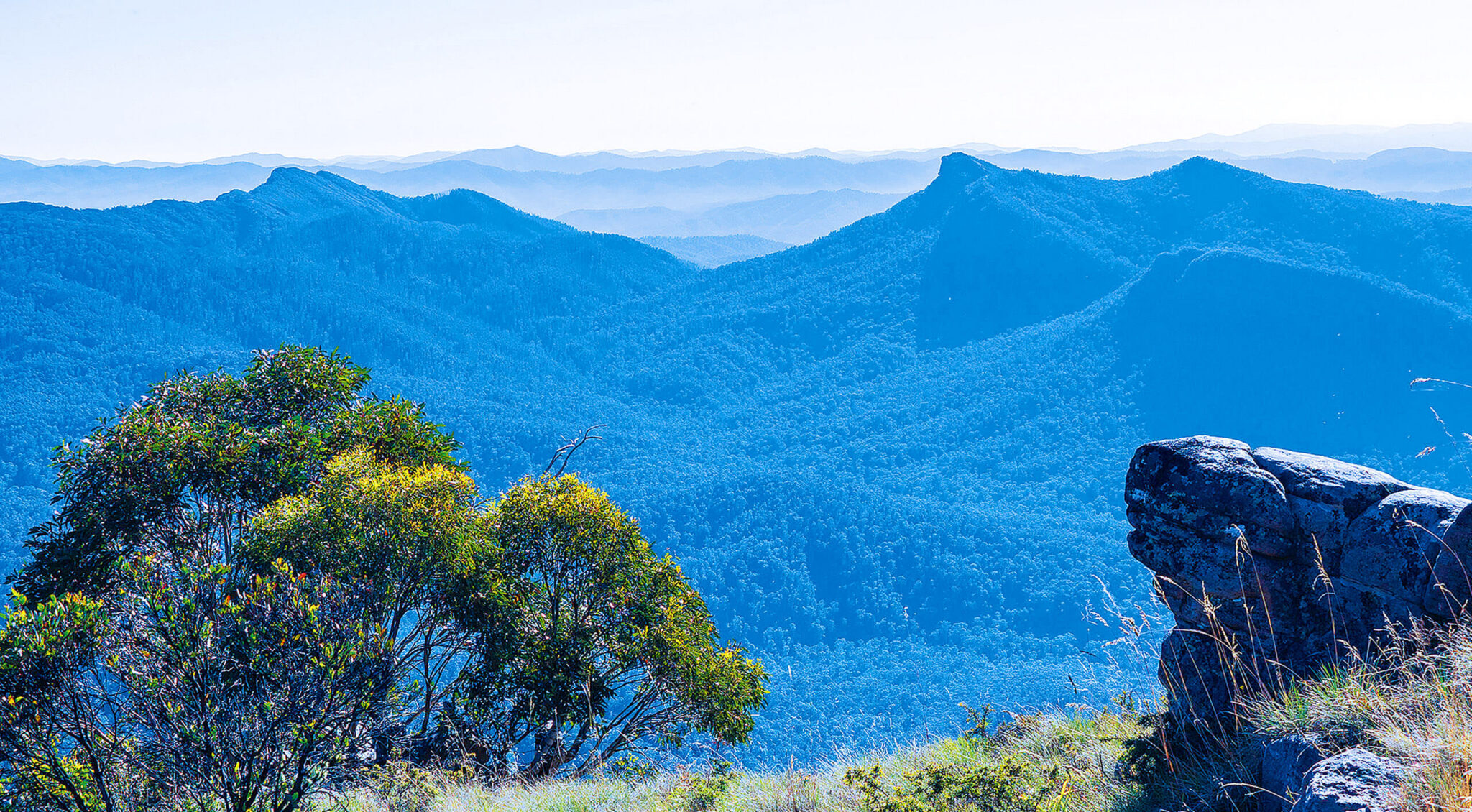

Mountains of Love
From a remote mountain in the South Australian desert to the summit of Jagungal, Huw Kingston retraces two climbs connected by love and nearly 25 years of memories.
Photography and words: Huw Kingston
(This story originally featured in Wild #199, Autumn 2026)
A few roos were grazing in front of the house, one with a ridiculously large joey squeezed into her pouch. Like some Gen Z’er, he probably should have left home long ago. The first light of dawn was colouring the gums. Through the window, first caffeine fix in hand, I admired the still unfinished crazy paving outside. The previous afternoon I’d dropped an arrow-shaped, white quartz rock into the jigsaw. It was perhaps the size of my hand, incongruous, an erratic among the greys and browns of the bluestone.
I’d placed it so as to best fit with the other, larger rocks around it. But now I followed the point of the arrow, followed it across to the neighbouring ridge, maybe two kilometres away. Kept following the line beyond other, more distant ridges. Followed it to Jagungal, a mountain I have loved for decades. It was why that window was where it was. A plan was hatched.
NEARLY A QUARTER OF A CENTURY EARLIER, I’d sat on the red dirt outside my tent, the bush flies having finally settled down for the night. Earlier that day, as I’d pushed my bike along a sandy track in the South Australian desert, I kicked an empty beer can, half buried, pissed off that someone had discarded it. My toes hardly rolled the can. I reached down; it was unopened, not empty. Anger turned to appreciation. So there I was, by my tent, with a VB in hand. In the desert, so often as the sun sets, the breeze sets too, the flies stop buzzing and all that is left is an immense, almost frightening silence.
Sipping the warm beer, I thought back a few months to the early days of my journey from Perth to Adelaide, a journey by foot, bike and kayak. Wendy had joined me to hike the Cape to Cape Track. Our last night together was at Cape Leeuwin, the southern end of the track, where the cool waters of the Southern Ocean meet the warmer flows of the Indian. It was the perfect place, but I got cold feet. The Southern Ocean won, an opportunity missed.
The can now emphatically empty, I climbed into the tent, wrote a few words in my diary, then checked the map for the coming days. Mt Kingston, 187 metres? I hadn’t noticed it before. A plan was hatched.
I’D BEEN TO JAGUNGAL, OUR MOST NORTHERLY and most lonesome 2,000m peak, many times in all seasons. The first time I went to climb it, by ski, Eda set the alarm on her watch for an early start. She placed the watch on the floorboards of Mawsons Hut, to ensure it rang loud enough to wake us both. We overslept, the watch no longer there, and missed our opportunity. I often wonder if it’s still there, under the floor or wherever, passed down from generation to generation of thieving bush rats as some family heirloom. (Ed: OMG, it was probably the grandfather of the same thieving bugger who stole my Garmin Fenix at Bluff Hut in the Vic Alps!!)
The summit was often, but not always, the goal. Sometimes a wide, 150km circumnavigation by mountain bike, sometimes to the foot of the mountain, just to pay homage or to be turned back by blizzards. Jagungal is a destination in itself, or a diversionary side trip as part of a longer journey, climbed from O’Keefes, Cesjacks or Derschkos Huts or a camp elsewhere. It is a mountain summit coveted by many others, of course.
With the paving at home complete, and with spring now rolled into summer, I set off from that terrace on a Cupid’s arrow trajectory directly for the summit of Jagungal. A beeline bushwalk, I called it.
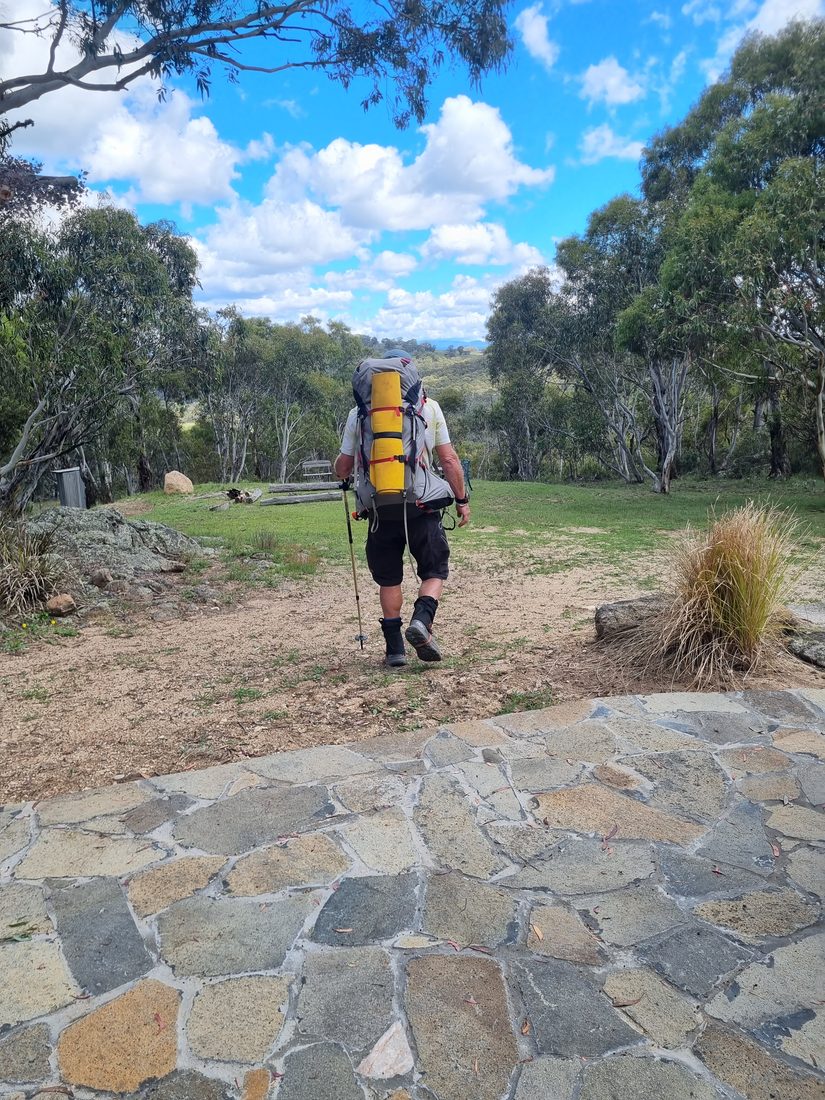
I reckoned it was close to 50km, a three- or four-day hike perhaps, depending on the amount of bushbashing. Wendy waved me off, and soon I was making my trackless way through the forested land of my neighbours, Jagungal well hidden. Things opened up as I crossed paddocks, most empty but some holding sheep or cattle. There were feral deer too, free ranging wherever they wanted, the latest in a litany of invasive species troubling the land.
I ducked low when passing near the occasional house, feeling a little naughty. I thought back to a sign I saw when travelling from Brisbane to Darwin, part of that same project that had seen me undertake Perth to Adelaide and five other City2City journeys around Australia. “Trespassers Shot. Survivors Prosecuted.” The owner hollered gruffly from his verandah, a shotgun over his shoulder. But soon I was enjoying the night, the wine and the banter with John and his family.
It was a hot day and, after scrambling down a steep, thorny hillside, I was glad to have reached Lake Jindabyne for a swim, a very late lunch and a brew.
I’d met Wendy in 1986 early on my first time to Australia, a backpacker fresh out of university on a year-long working-holiday visa. The same year as that rat stole Eda’s watch, the year I first fell for our highest country. But it was another twelve years before we could walk freely together. Love, like life, rarely travels straight. For a long time, I stopped to pick up rocks, shells, pebbles from across the world for Wendy. Just reaching down when the mood took me, not selecting them for any particular weirdness or beauty. Just because. She had quite a collection.
MT KINGSTON WAS ABOUT SEVEN KILOMETRES off the track, a prominent albeit low bump, on the vast Anna Creek cattle station, itself then still part of the huge Kidman Cattle Company’s holdings. I left my bike and trailer and set off across the gibber plains, the cleats on my bike shoes clattering like tap shoes on the rounded stones. I imagined there couldn’t be many, perhaps any, who also coveted the summit of Mt Kingston.
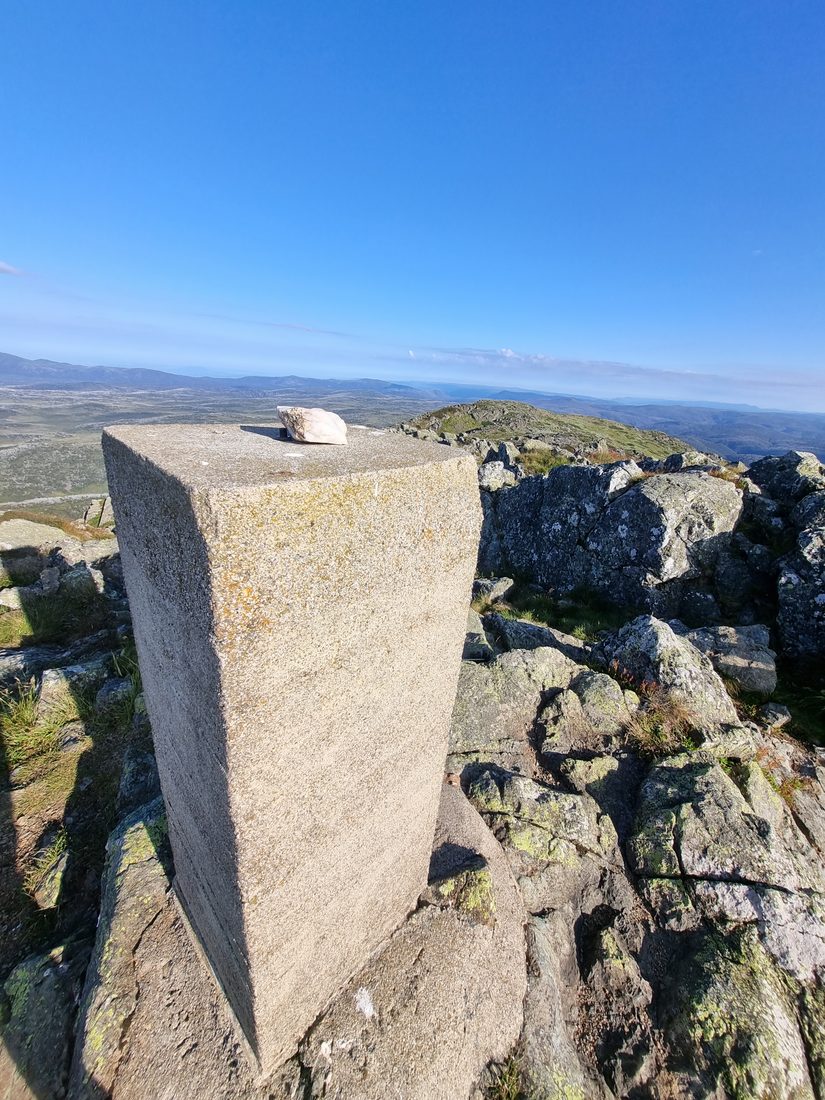
I remembered the day as my parents’ 40th wedding anniversary. Hamming it up as some ascent of Himalayan proportions, when I reached a low, rocky rib, with a narrow gap in it, I called it Jackie’s Pass, as it was through my mother, Jackie, that I’d passed to become a Kingston. Up onto the summit plateau to a small cairn marking the top. Now acting as some Scott, I wondered which Amundsen had beaten me to it? White quartz rock was scattered like snow across the top.
A COUPLE OF WINTERS BEFORE MY BEELINE TO JAGUNGAL, I skied the length of the Australian Alps. Before I set off, Uncle Shane, an Elder of the Taungurung people, honoured me with a smoking ceremony as the snow fell. Afterwards we chatted about many things, including the difficulty of trying to regather lost stories when they were never written down. Shane then told me how tribes in the desert country of Central Australia held tales of this white stuff in the mountains far to the east, how these tribes helped the First Peoples of the alpine country with this regathering.
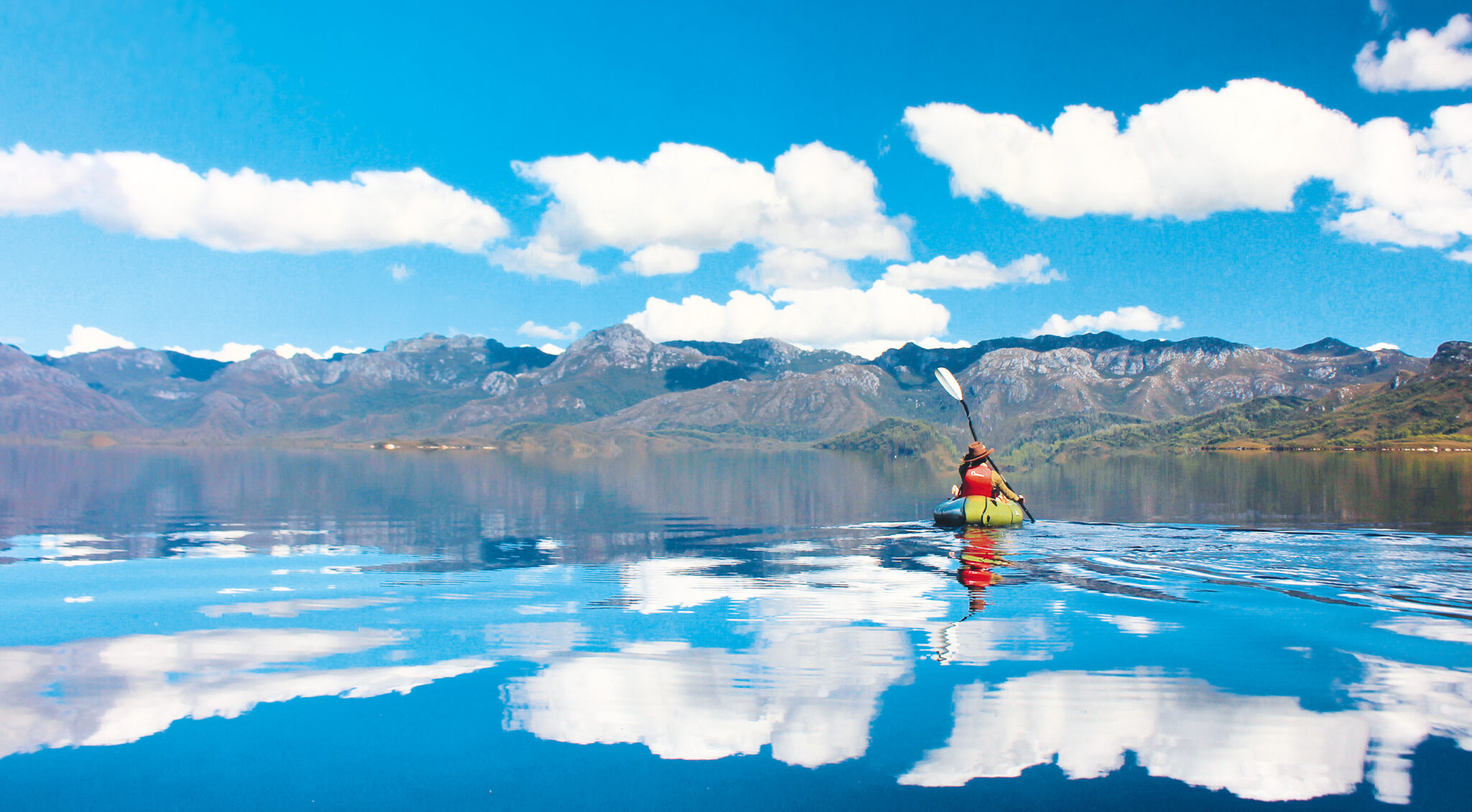
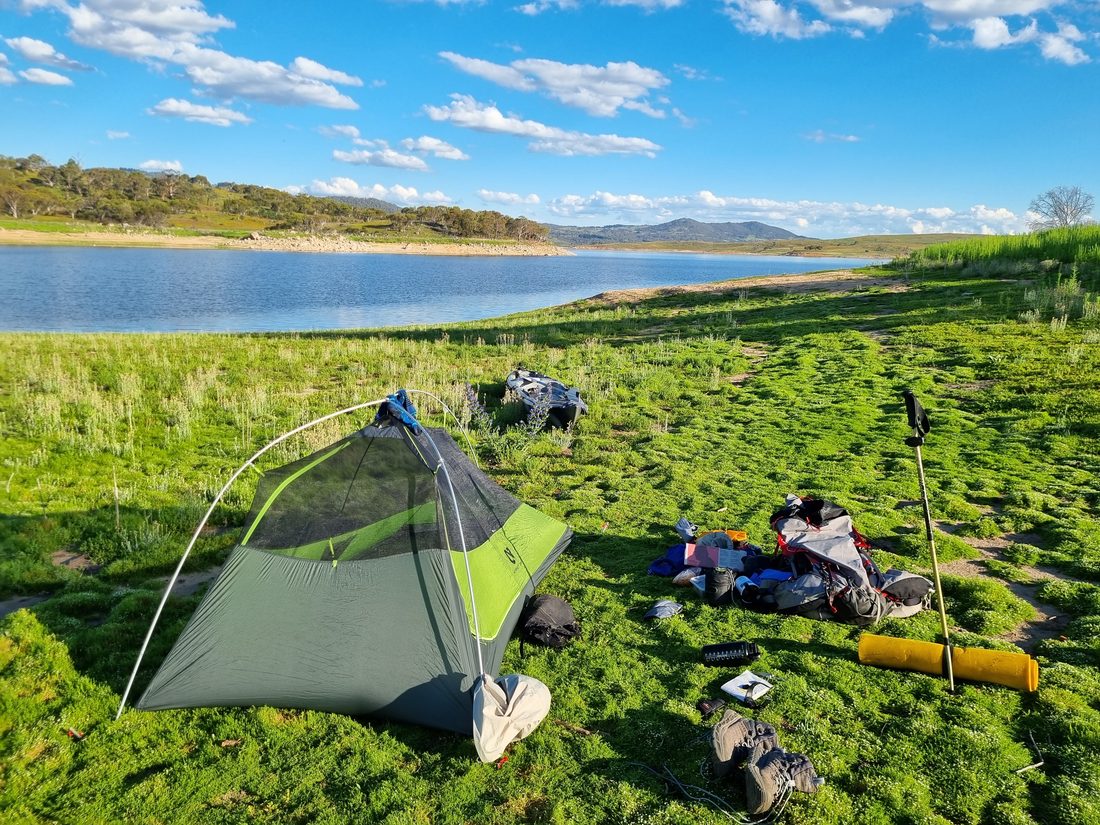
I’d pre-placed a kayak on Lake Jindabyne so, securing my pack, I paddled the five kilometres across the lake. The water was calm in the early evening as I guided the boat to where the Snowy and Thredbo Rivers used to confluence, then into Horseshoe Bay, where more than a hundred kangaroos welcomed me. I dragged the kayak up to a grassy spot and made camp. I was more tired than I should have been, but happy to have held the line.
In Kosciuszko National Park now, the march flies flew in waiting for me in the morning. Given I’d not seen any the previous day, I wondered how they knew where the park boundary was? They chased me up the hill, nipping at my skin at any opportunity, through my clothing too. But I was an easy catch. For sure the slope was steep, but I felt so weak. My pack wasn’t particularly heavy, I wasn’t particularly unfit, the bush wasn’t particularly thick.
I was so slow, stopping to catch my breath after too few steps, my heart pounding. It felt like an altitude thing, but I wasn’t at altitude. My beeline for today still had a lot more climbing in it. Concerned a little for my health, I decided to go offline, to drop down to the track at Kalkite Gap and then head for Snowy Plain and Daveys Hut. I reasoned that if the issue worsened it was better to be on a track than thick in the bush. Life, like love, rarely travels straight.
By the time I reached Daveys Hut, I was shattered and still puzzled. It had been a too long, too slow day. It was good just to stop, have a good feed, a few brews, sleep. Strangely, on the hut table was the torn-off cover for a funeral service: ‘Elizabeth Ann Death – March 30 1950 to September 30 2021.’
UP ON THE SUMMIT OF MT KINGSTON, I gathered some rocks. One about the size of a golf ball, plus a couple of larger pieces. Such missions are, I find, far easier than shopping. Then I started down, back across the desert to the track, to my bike and to camp.
The flies in the desert were relentless. The forward party would knock on the mesh soon after dawn and, by the time I was up, the army had usually arrived. As a temporary diversionary measure, while I breakfasted and packed up, I’d have my morning crap close to the tent, a movement advisable only if travelling solo. Briefly, the flies would then leave me alone. Briefly.
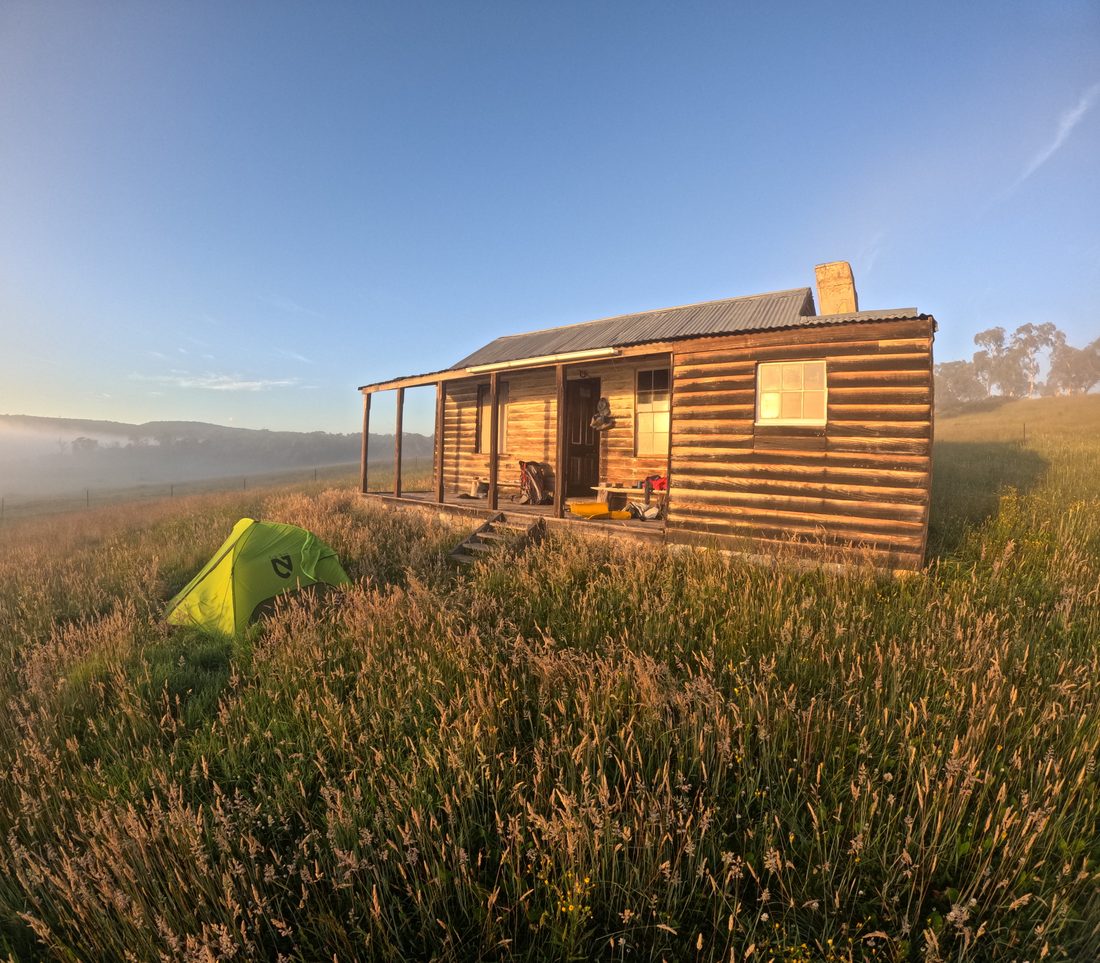
A MISTY DAWN GREETED ME at Daveys Hut, soon burned off by the summer sun. Without exception, until that morning, I’d always seen mobs of feral horses when visiting Snowy Plain. Perhaps, after sense prevailed and aerial culling finally allowed, the numbers were now being controlled, numbers that were causing so much damage to flora and fauna in the high country.
I felt better, stronger, like my own fog had lifted, and I set off to get back onto the line, first following a good trail up to Brassy Gap, then descending a much thinner one to Kidmans Hut. The march flies attacked me at every opportunity. An insanity of flies seemed a reasonable collective noun. I took shelter in the tiny hut.
The land itself near Kidmans was badly broken by pigs, tussock turned over all around. Skiing near here a few years earlier, a pig attacked one of our group. Brian fell backwards on his skis, eventually fending off the pig with his poles.
I was back on the beeline (flyline is perhaps a better term). To follow that line again, I needed to climb above Kidmans, then cut west to Bulls Peaks. I set off, bushbashing through thick regrowth but, after less than 100m, I lost interest. Challenge has its own rewards, but I was there because I fully loved that country so much. I didn’t want to hate it, to fall out with it, to be half-hearted in my approach.
“On top was a question mark made of chocolate buttons, the dot below a white, golf ball size rock, outsized in its surroundings.”
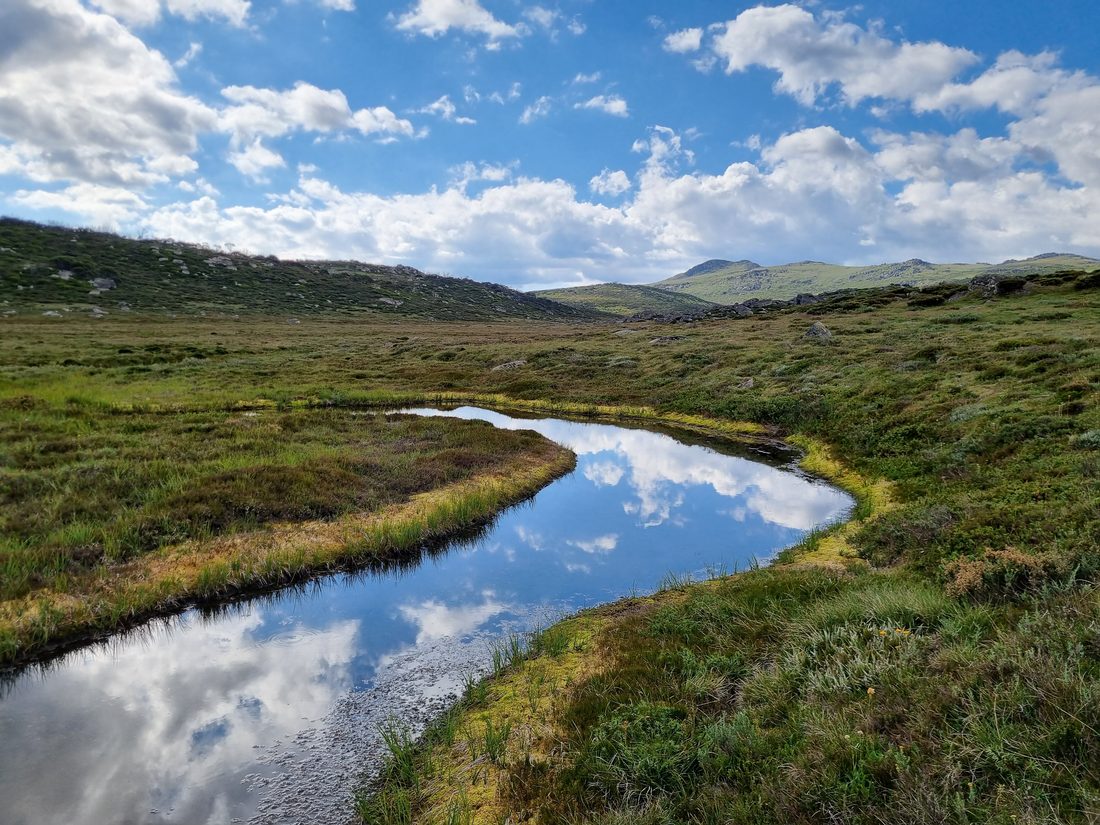
Returning to near the hut, I followed a very thin, occasionally taped route up the Burrungubugge, past the site of the old Alpine Hut. Two hours from Kidmans I was up above the treeline at 1,750m, traversing tussock, sphagnum and snowgrass country, the Bulls Peaks clear to my north.
Cup and Saucer, Tarn Bluff and Mailbox Hill dropped behind me, the bulk of Jagungal slowly filling my view. At the Geehi River, I took the spur where the infant river forked, camping on soft snowgrass among some stunted, twisted snowgums. The summit was in full view, just a couple of kilometres away.
ON THE 111TH AND LAST DAY of that 2001 journey from Perth to Adelaide, Wendy met me late in the afternoon on the beach at Grange. That final day had been a near twelve-hour paddle across the Gulf of St Vincent, the last sixty kilometres of a 6,000km journey.
Two weeks later, back home, it was her birthday. I’d never made a cheese souffle before or since, but I did for dinner. It was a cold night in August but, determined to not get cold feet again, the fire was roaring. After we had both devoured the souffle, I brought out a cake that had not risen to the occasion as much as I’d have liked. On top was a question mark made of chocolate buttons, the dot below a white, golf-ball size rock, outsized in its surroundings. It was the last rock I would ever pick up for Wendy, should she deign to become a Kingston.
I COULD HAVE GONE TO JAGUNGAL’S SUMMIT that evening, but wanted to savour the view, an animist worship from the back of this crouching lion. Looking up to the summit yes, but also back across the country which I’d traversed. Then south in the direction of Mawsons Hut and Valentine Hut. When I’d drawn the line from that quartz paving rock at home to Jagungal, I also drew one direct to Mt Kingston. Early on its 3,000km journey, it passed through Valentine, that red, romantic hut of hearts. Another journey perhaps?
Closer, I looked across Jagungal Saddle to Jackys Lookout, and thought back through the years to Jackie’s Pass and Mt Kingston.
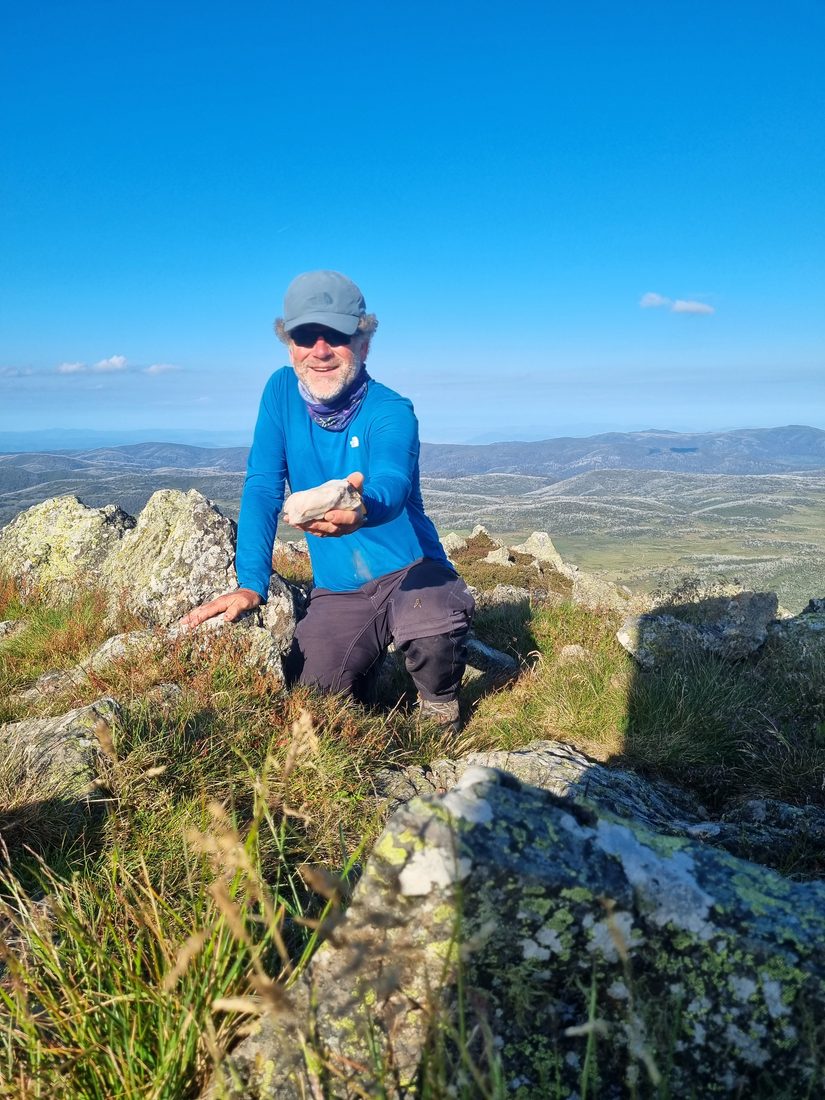
It was a perfect morning, a strong breeze giving a break from the flies, and it took me less than an hour to the summit of Jagungal. Pulling from the pack my last chunk of Mt Kingston quartz, I looked toward the distant Main Range, the cluster of peaks making up the rest of our 2,000m mountains. My eyes then swung around again to the southeast, along the ECG line I’d ultimately followed from home. I hid the rock on Jagungal’s summit, perhaps to confound geologists if ever found.
My route out was now east, across Doubtful Creek to Cesjacks Hut and beyond. The darkest of clouds were gathering and, as I climbed up Nimmo Hill, I turned around for one last view of Jagungal. But it was gone, hidden by an almost total blackout.
Then it bucketed down, torrents running across my boots, cascades down my neck. At the top of the hill was a car. Wendy was rescuing me as she so often has. Doubtless the best wife I’ve had, the first I married.
Conquistadors of the Useless—that’s how pioneering French alpinist Lionel Terray termed mountain ventures. But it’s worthwhile uselessness all the same.
If you liked this piece, you should subscribe to the print mag. Only a fraction of the great stories we run in the mag make it to our website; if you want to read them, head to subscribe.wild.com.au