
Celebrating Fifty On The Franklin
Fifty years after The Wilderness Society was founded to help save the Franklin River, Jimmy Cordwell joins a commemorative journey down one of Australia’s most significant wild rivers, exploring its enduring legacy and the ongoing fight for wilderness.
Photography: Anna Brozek
(This story originally featured in Wild #199, Autumn 2026)
In 1976, a group of concerned citizens, among them Bob Brown, gathered to determine what they could do to halt the proposed destruction of one of the planet’s most precious places—the Franklin River. They decided to create what is now known as The Wilderness Society. Fifty years on, to celebrate its birthday, members of the society gathered to paddle the river where it all began.
Our experience paddling the Franklin River begins with the most important piece of information: river levels. For the past fortnight, I’ve been watching the levels of the Collingwood and Franklin Rivers pulse with every drop of rain. Every few hours, I open the Hydro website and review the data as it ebbs and flows. I’m tracking the weather of the West Coast, Central, and Southeast parts of the island too, comparing across multiple tabs the accuracy of precipitation forecasts from various sources. It’s been a particularly wet spring here in Lutruwita/Tasmania—one of the wettest in fifty-odd years—and the catchments are sodden, with fresh rainfall zipping off over the surface and bumping water levels up rapidly. These meteorological musings almost become my every waking moment: Will it be raining for a week prior and the river be on the rise? Or will levels be falling, and will five rain-free, sunny days lie ahead? How recently has it been really pumping, washing out or causing new navigational challenges along the route?
Then we get the text: It’s on. Two days later, we’re pulling off the Lyell at the Collingwood, unpacking eight days of gear and supplies under the bridge as unsuspecting cars fly overhead on the bitumen at 100 clicks. A water meter awaits us, glued to the bridge pillar. Over 1.6m? We’re gonna have a tough time handling a flow that high in a few places; it’d be best to wait it out. Below .5? Well, it’s not a worry this time, but in drier times over summer, levels this low mean dragging the rafts over exposed rocky sections, sections that you’d simply cruise over with higher water levels. We take bets on the approach: It’s 1.4m; our guides are stoked.
After the stress of whether or not the trip would go ahead, we’re stoked too.

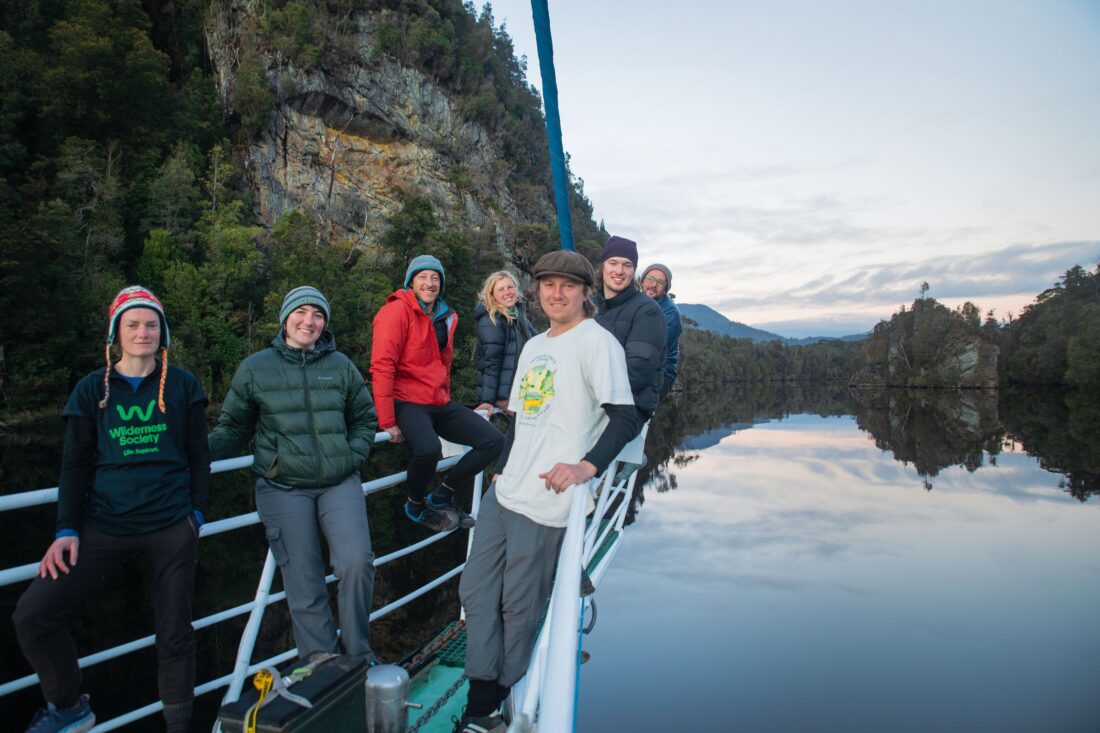
I’M SURROUNDED BY A BIT of a rowdy bunch. In the bus on the way to our drop off, one of us Zooms into a board meeting, urgently filing a court case to challenge the logging of critical breeding habitat of the endangered swift parrot; another to my left dissects an upcoming ministerial decision regarding parks privatisation; to the back of the bus, one reels off a list of measurements of the extreme girth of the giant trees they were measuring in the southern forest the previous morning. Most of us have spent cold nights in trees, up on tripods, or locked on to ‘dozers.
But there is something that unites us—The Wilderness Society (henceforth TWS, and affectionally pronounced ‘Twiz’), founded in 1976. Eight members of the Tassie team (me included) have set off from TWS’s office in Nipaluna/Hobart to celebrate both the organisation’s fiftieth birthday and its defining achievement—that the mighty Franklin River still flows free.
The historic decision in 1983 to preserve the river—Tasmania’s last major free-flowing river, all others having previously been dammed by the state’s Hydro-Electric Commission—literally rewrote Australian federal law and unseated a premier. (You can read about the campaign in detail in Wild #173’s definitive piece ‘The Battle for the Franklin’.) But the victory to stop the proposed network of hydro-electric dams only came about after many long and hard-fought years. The campaign involved TWS activating tens of thousands of people across the country to help save this river from destruction, but one key element included assisting folk to take a trip down the Franklin itself.
TWS lore has it that at the Davey Street office, travellers could rock up on the doorstep and borrow a rubber ducky, a paddle, and a guide to the river (plus meet other adventurous keen beans to team up with). A week or so later, they’d return—some with popped rafts and no paddles—with stories and memories to last a lifetime. Almost all came back forever changed by the wild river, with a priceless tangible connection to this place of wilderness. This became the signature TWS modus operandi—facilitate a connection, let the wild do its thing, and create lifelong advocates. It’s a method which has since been rolled out in campaigns across the continent to protect other wild places.
(Ed’s note: In fact, it was a rafting trip with Paul Smith down the Franklin in 1976 that Bob Brown credits for igniting his passion for environmental activism. Prior to that trip (which, incidentally, was the first ever done in an inflatable raft), Bob’s background in environmental activism was, he told me, “None. Zero. Zilch.” Mesmerised by the Franklin’s beauty, and appalled by its impending destruction, Bob soon after had a meeting at his place in Liffey, attended by sixteen people including himself. Together, they resolved to save the Franklin. And to do so, the group formed the Tasmanian Wilderness Society that very night with Kevin Keirnan as its director.)
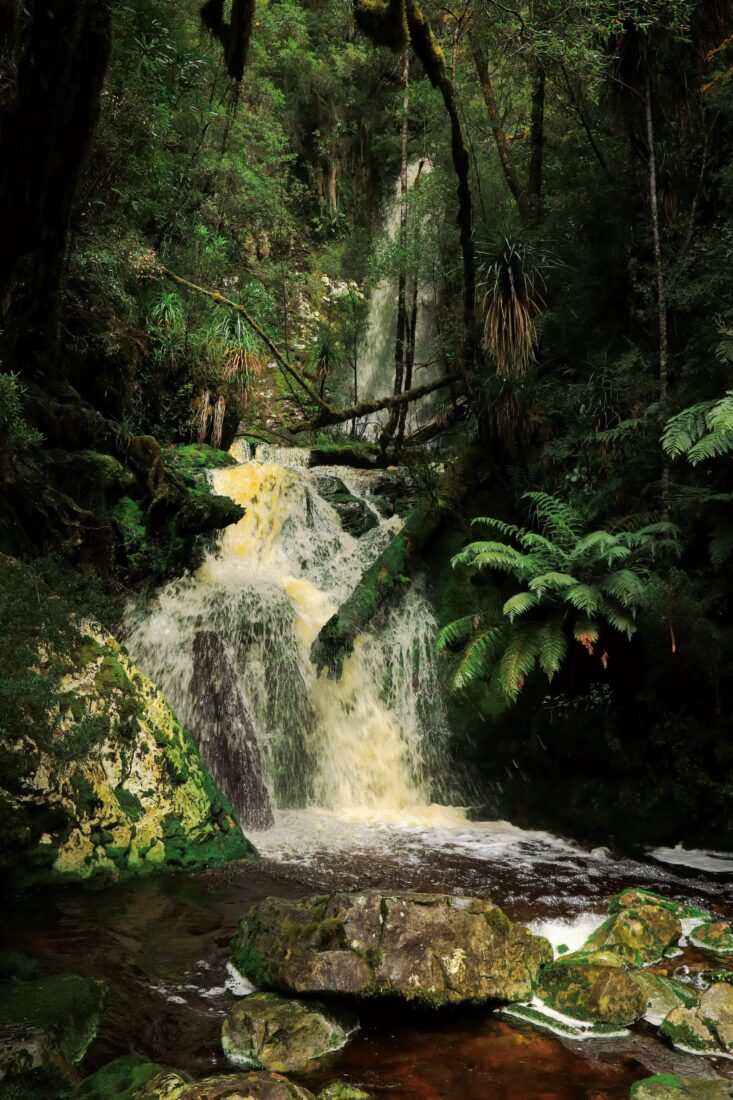
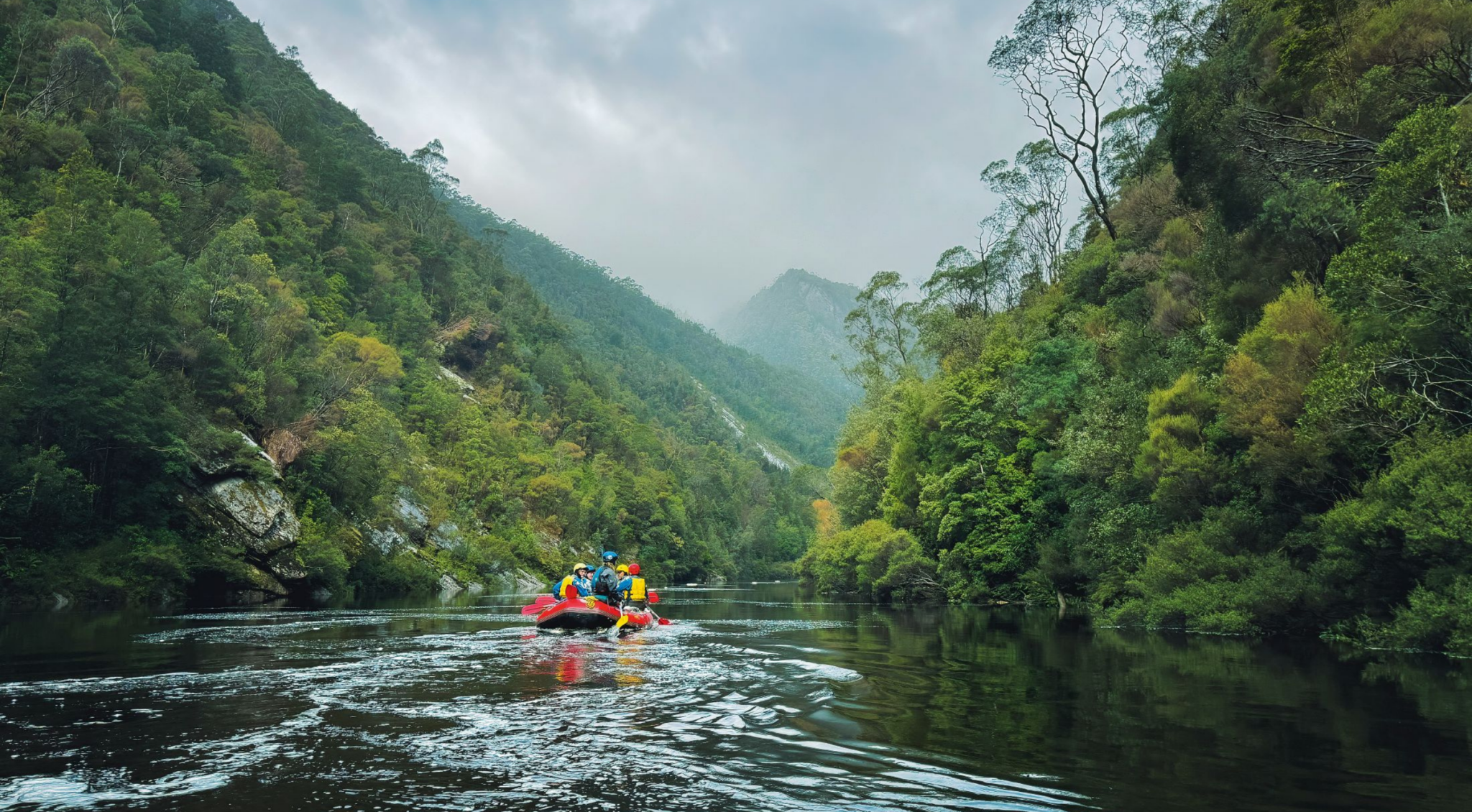
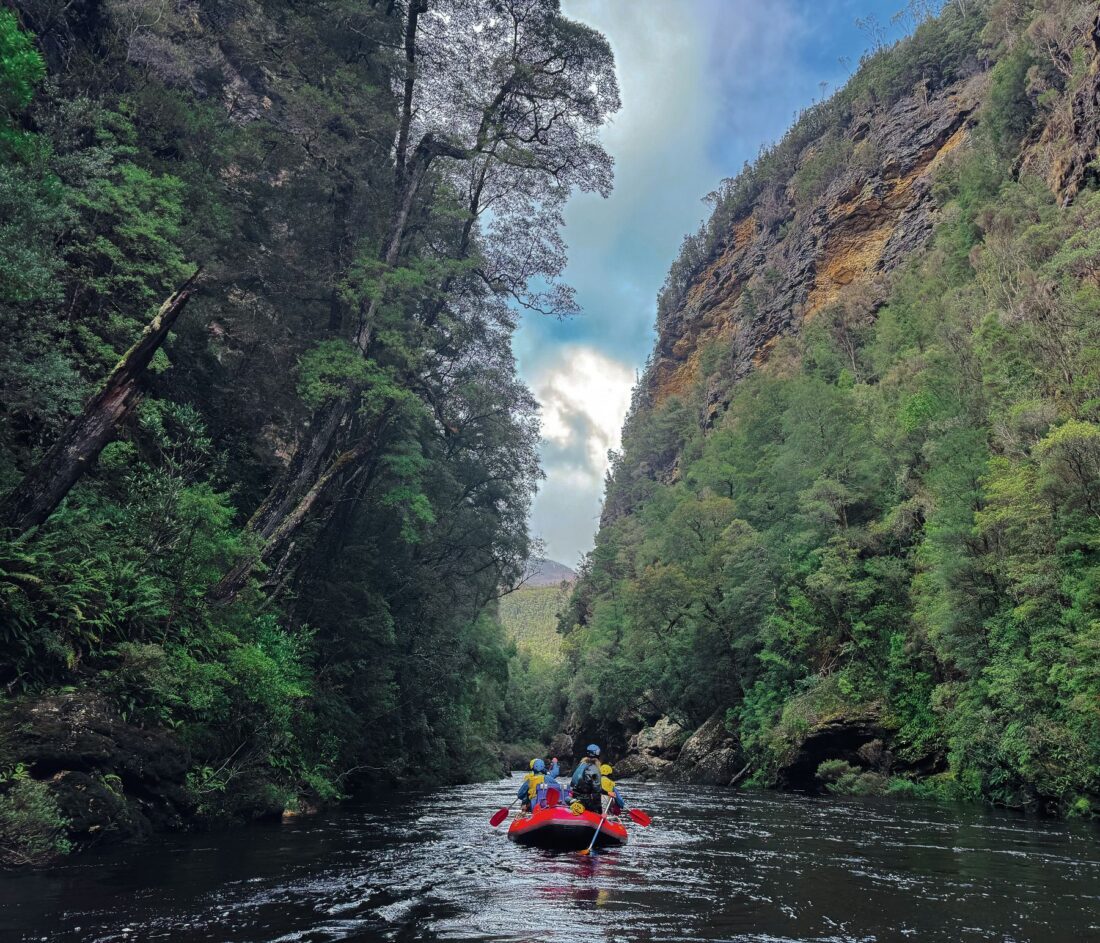
THE WILD FEELING FROM BEING on the river is something else. Being a lifelong bushwalker with minimal raft time under my belt, I’m accustomed to peering over cliff edges or sneaking a peek at the landscape through the scrub. But here in the raft, you’re out in front, with a whole gallery of vegetation rising around you. A Southwest mist hangs in the air, while a slight breeze kicks up ripples on river right. From the hardy river’s-edge-dwelling species—recently battered by flood and loaded with fresh limbs and dislodged trunks—the bush slowly fades into myrtle and eucalypt and, in parts, into open fields of buttongrass. Here and there, a dead stag of a conifer stands out too, a grey-white ghost spire defying time and the pull of gravity.
Due to the nice flow and high energy levels in the team, we make it to camp early, and for a moment before dinner we retreat to sleeping bags, each reading the books we’ve brought on the journey. Titles jammed into dry sacks include Cod: A Biography of the Fish That Changed the World, Dharma Bums, and Bob Brown’s new book, Defiance. On my way out the door, I grabbed my soon-to-be-battered copy of A Sand County Almanac, written by Aldo Leopold (one of the founders of The Wilderness Society in the US) in the 1940s. Aldo’s stories of the unique ecology of North America—most notably the open prairies—still provides us with spectacularly vivid insights into his masterful ecological-observation skills. Importantly, the book explores wild landscapes and the threats that faced them seventy-odd years ago: “Industry is like a hypochondriac who doesn’t know what’s healthy for itself.” It was that same industry that tried, but failed, to consume the roaring river below us.
My eyes well up in tears. Huon pines and a wild river. Here we are, experiencing this world heritage wonder first-hand for the first time.
OUR EXPERIENCE WITH THIS RIVER hinges on the experience of our leaders, and with over twenty years’ experience on the Franklin alone, we’re in the best of hands. Elias and Benny can recite the river’s many bends from memory, along with the sights, camping spots, stories, eddies, boils, notches and churnings. They’re thinking hundreds of metres—indeed days—ahead. They describe the route through each rapid, along with how we can tackle it and the risks involved. Sometimes, this occurs well before we’ve even spotted the next obstacle; slowing the raft on the end of our third day, they encourage us to listen, as the roar of the Coruscades in the distance reverberates off the towering cliffs around us. We attempt to garner a bit more knowledge ourselves, poring over maps at camp—complete with the nomenclature for almost every rapid and major feature—and share the pages of Shooting the Franklin, the book by John Dean about his nearly decade-long quest to be the first to paddle the river, a feat accomplished in 1958. (See Wild’s profile on John in Issue #173.)
Our guides’ experience on the river is evident, but so is their passion, which isn’t watered down from the frequency of their visits. They understand the reverence this landscape inspires in those who behold it for the first time, which is encouraged in moments when we enter slower sections of the river: “Paddles in, crew,” followed by a leading silence. Conversation tapers off, sometimes the whole raft becomes struck with a quiet awe, drinking up the quiet surroundings.
For the first few days—as we track our way down through the Upper and Middle Franklin—in these quiet moments, my brain darts like my hurried forward- and back-paddle strokes when tackling a rapid. It always takes me a few days out bush to unwind, to leave behind the pressure cooker of work, commute, and mortgage. Eventually, it slows. As you, dear reader, can probably appreciate, the power of the bush calms like no other. I mull over a line from Aldo I read that morning, “Our ability to perceive quality in nature begins, as in art, with the pretty.” I build on this thought, in a place that’s objectively fucking grand.
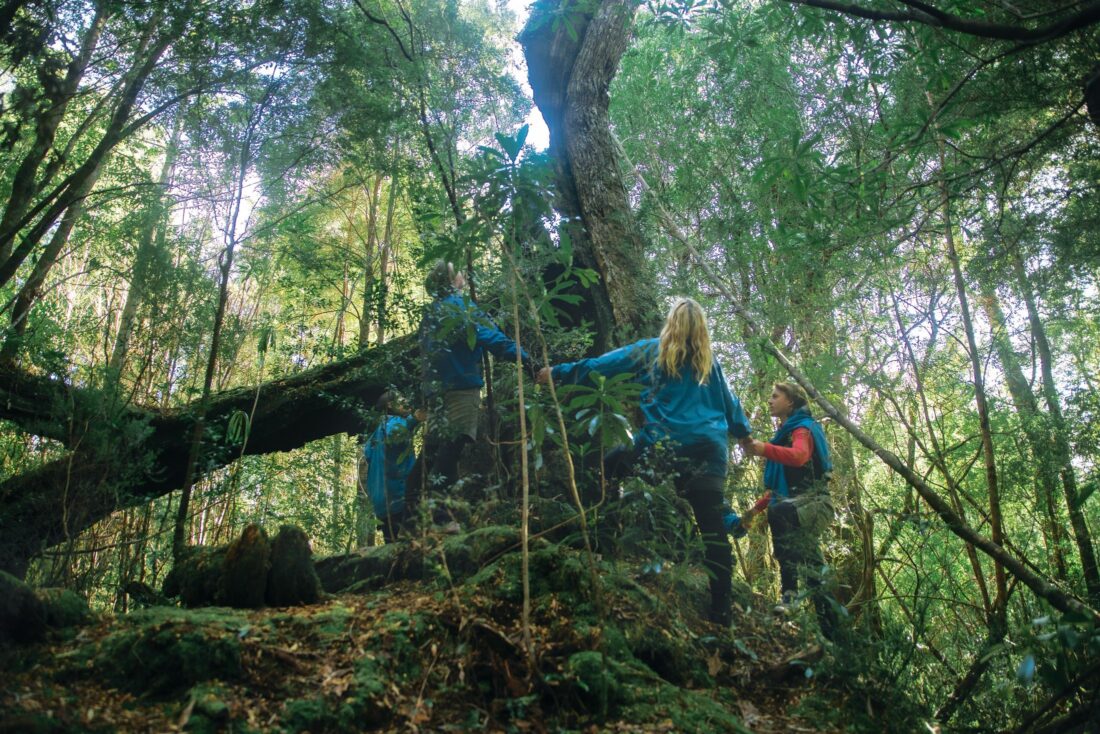
We enter another soft spot of the river, and yet another platypus (the centrepiece of the original TWS logo) pops up in front of the raft. This is to be a regular symbolic occurrence every day on the trip. Rounding the bend, Danny asks me what I’m thinking about. I’m caught off guard, and ramble something about the gallery forest, then gather myself as I delve into the special feeling of being in the presence of the thousand plus-year-old trees which flank the river’s edge. It’s pretty special, we agree. I get the words out and drift off into silence. My eyes well up in tears. Huon pines and a wild river. The wins are hard-fought; but here we are, experiencing this World Heritage wonder first-hand for the first time.
THE CONCEPT OF SHIFTING BASELINES is used to describe alterations which create generational differences in understandings of our surroundings. It’s increasingly used to describe changes to the environment over time. For example, our baseline today is one of a gorge-shaping, free-flowing Franklin. The water travels through a large catchment entirely free of dams, farms, mines and houses. There’s one road crossing—the Lyell—and a dilapidated hydro shack. In essence, the landscape operates much as it always has, and therefore my grandparents, myself, and kids in fifty years will all share a very similar baseline which hasn’t shifted much at all. In an alternate universe somewhere, there’s a different baseline. Three dams are erected: one near the Gordon-Franklin confluence, another at Propsting Gorge, and a third at Irenabyss. Gorgeous gorges, one after the other, are all inundated. The forest—once rich in Gondwana relic vegetation like iconic Huon and celery-top pine—are no more. The caves dotted throughout the limestone country of the Lower Franklin—with records of Tasmanian Aboriginal settlement stretching back through past ice ages and tens of thousands of years—drowned forever.
The Franklin got lucky, but we don’t have to travel to an alternate universe to visit shifted baselines. At the foundational heart of The Wilderness Society rests the memory and loss of the glacial gem that didn’t make it: the dammed Lake Pedder. Those on this trip were all born after the event, and we inherited a new, shifted baseline. Life lived alongside that glacially shaped, World Heritage-listed, pink-sanded gem was stolen from us, living on only as a memory for a dwindling few. This event broke many hearts, and it inspired our organisation’s formation at Bob Brown’s place in Oura Oura, in June 1976.
While saving Pedder might not have been successful, it primed environmentalists on the continent’s eastern seaboard to be ready for the next onslaught of industry. The lessons of Pedder meant those that cared made it their business to ensure that the Franklin—and the Collingwood, Loddon, Jane and more—would not suffer the same fate.
IT’S HAILING. OUR HANDS ARE FROZEN to our paddles. Loading into our boats, we’ve got a big day ahead. We pull up before Pig Trough rapids, and while Elias and Benny undertake an awesome-looking portage, we creep around between one of the final slabs of quartz on this trip. Meandering slowly over slippery rock that’s been hibernating in the winter shade, then through lush, fern-filled forest, we soon pop out into the sunshine, and into the iconic view of Rock Island Bend.
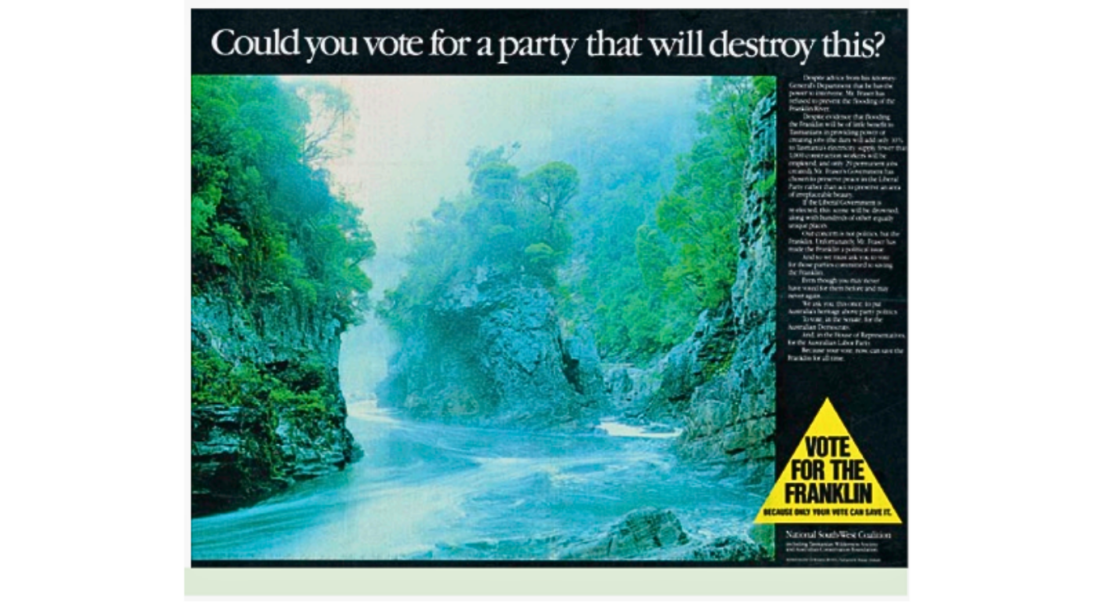
Beautiful communication that gives a voice to an environment under threat is essential in environmental conservation. In the first half of the 20th century, Aldo used the tools of the time—the written word, brilliant hand-drawn images of wildlife, and increasingly accessible printing distribution. Decades later, in the 80s, as colour photography and colour printing began to go mainstream*, TWS (and photographer Peter Dombrovskis) gave us the iconic photo of Rock Island Bend (see above). Distributed in newspapers nationally on the eve of the ’83 election, this single image helped turn the result. While there’s arguably never been an Australian photograph that’s had the same impact in conservation, beautiful imagery and a well-written argument continue to have an impact. With the evolving times, a new raft of tools (eg TikTok reels) competes with frayed attention spans (ie scrolling and flooded inboxes), presenting both opportunities and challenges for giving a voice to the natural world.
As someone who lugs around a heavy camera, I search for the spot Peter stood, using an image on my phone for reference. I find the spot, but—and how’s this for the Southwest—the light was shocking. Too much sunshine! Instead, I detach myself from the group and just drink up this iconic bend. I feel like one small drop in a river of people that have been working for a very long time to protect places like this. This place—Rock Island Bend—galvanised the environmental movement and the Australian public in the 1980s, and has captured the heart of millions since. This location is still here because of people. People who gave the river a voice, and projected that voice all over the country (and the world) when it needed it.
FIFTY YEARS. THAT’S A FAIR HAUL to keep an organisation afloat, let alone with quite a track record. From the heartbreak of losing Pedder to the success of saving the Franklin, a movement grew across the continent alongside the TWS banner to help defend our wild baselines. Like all families, we’ve got our characters and had our blowouts (both internally and wonderfully public). But—and most importantly—the TWS family has centred on the importance of wilderness, so much so that together we believed we could protect global gems like the Great Australian Bight, the Kimberley, Cape York, our threatened temperate forests, and more. And together, with a multi-generational community of supporters around the continent, we have. Saved them, that is. These vast, undeveloped regions of a spectacular continent retain their wild character and baselines thanks to people giving a shit and, most importantly, getting active. Protecting these places has granted them a distance from industry, ensuring they have the best chances of handling the challenges ahead. These areas of outstanding cultural and natural values also provide us a baseline of normality which will steer us through the restoration of damaged landscapes—including the restoration of the precious Lake Pedder (a key provision for its inclusion in the World Heritage area)—and to reverse the climate and biodiversity impacts through the remainder of this century.
NEARING THE END OF OUR TRIP, we paddle from our last camp and across the Gordon River to Warners Landing. Hiking up into a pocket of forest, our legs have clearly missed the workout our arms have been getting over the past week. We’re surrounded by disturbed-but-reviving forest, forest levelled by advancing bulldozers on route to dam site number one.The plan was then to cross Lake King William and hike across the plains to meet the Gordon River, which we’d then paddle all the way to Lake Gordon. However, in our preliminary research, information on the upper Gordon River was scant. The word “logjammed” cropped up repeatedly at any mention of paddling the Gordon, but how bad could it be?
After following a bit of flagging tape for a while, we pop out into some ancient, open rainforest. In the centre of this clearing stands the Lea Tree. Here, in the days following the High Court decision to stop dam works and to protect the World Heritage-listed Franklin, a group of pro-dammers chainsawed it up, poured fuel over it, lit it on fire, and graffitied “Fuck you green cunts” on it. Yet at more than 2,000 years old—and despite this utterly disgusting vandalism—this extremely fire-sensitive Huon pine still survives. How symbolic.
These species and places continue to give us so much, yet—pushing on through the challenges—still ask for so little.
WITH PEDDER IN MY HEART and the Franklin commanding my every sense, I’m humbled by and eternally grateful for those before us, whose hard work and dedication to wild places helped set the stage for a half century of conservation work. Folk who changed the baseline of what’s possible in conservation, and for the better.
However, as they’d tell you—and as I will now—the insatiable desires of rampant industry remain the perpetual nemesis of wildness. Be it for ore, timber, fossil fuels or tourism, the unchecked desires of industry for ever larger quantities of produce will devour whatever wilderness we leave undefended. As I type, industry’s pushing for dams on the Martuwarra/Fitzroy River, for oil and gas reserves off the continent’s south coast, for private developments in national parks in every state; meanwhile, chainsaws are gunning for the last of our unprotected forest giants. But in the face of this, we remain hopeful. And we remain active.
So, here’s to fifty more years of defending wilderness: For seeing out native-forest logging; for ending the wholesale privatisation and development of public places; for treaty and land returns to Indigenous communities; for World Heritage protection for the Spero-Wanderer, the Bight, and more …
And here’s also to wild and free baselines: then, now, and forever.
If you liked this piece, you should subscribe to the print mag. Only a fraction of the great stories we run in the mag make it to our website; if you want to read them, head to subscribe.wild.com.au