
Circumnavigating Life: Kayaking Palau’s Rock Islands
Diehard hiker Dan Slater has been transitioning towards a new obsession—paddling. And what better place to discover the kayaking equivalent of summit fever than Palau.
Photography: Dan Slater
(This story originally featured in Wild #198, Summer 2025)
For most of my adult life, I’ve been a diehard hiker. It’s been my passion, my obsession, my every holiday, virtually synonymous with annual leave. I knew fighting it was useless when it became impossible to look at a beautiful peak without simultaneously feeling the urge to stand at its summit. The more achievable the objective, the stronger the magnetism, hence distant snow-capped mountains exerted less of a pull (although I have climbed a few of those in my time).
However, in recent years my body has become a battleground, my immune system attacking its host in the neurological equivalent of an own goal. Hiking has become more difficult. Not impossible, but I’m no longer capable of legging it up every hill I come across. So I’ve fiddled with my internal equalisation sliders, decreasing the leg output and increasing the arm output as I transition more towards kayaking as my major pastime. I still feel the lure of high places, but as my lower limbs become more recalcitrant, I can no longer satisfy it. After all, I can’t paddle uphill.

“OH, REALLY? WHAT COUNTRY IS THAT IN THEN?” It’s probably the most common response I get when I tell people I’m going to Palau. I can’t blame them; the name sounds more like a piece of furniture, or the graphic-novel sound bubble that accompanies a hero punching a bad guy in the chops. More realistically, the small archipelagic nation is known for its involvement in the Pacific theatre during the late stages of WWII.
Before learning about Southern Sea Ventures’ (SSV) week-long expedition-kayaking trip, my own personal knowledge was limited to Jellyfish Lake, a lagoon to which tourists travel from across the world in order to snorkel among floating, stingless blobs of goo. A pity then that the gelatinous population of the lake has, so to speak, fallen off a cliff in recent years. It may yet recover, but for now there’s nothing worth seeing. They may as well change its name to ‘Lake’. Theories for the decline include rising sea temperatures, excess sunscreen in the water from an estimated 100,000 swimmers a year, and (my own) an ill-advised deal with a visiting trifle magnate. The truth remains elusive, but fortunately there is plenty more to Palau than stingless blobs of goo.
After one night in Koror—a capital city the size of a small Australian rural town in which I experience Palau’s #2 local cuisine (Spam fries—as delicious as they sound)—I’m raring to go. The country is comprised of a main body of volcanic basalt waving a fragmented tail of limestone islets, sharp and junglefied and beautiful. It’s this complex, the Rock Islands, that the nine members of our group will be exploring along with SSV guides Chris (Australian) and Mac (Palauan).
Generally, I’m more of a DIY adventurer, but the logistics required to organise a trip of this length, in a country this remote, would result in a headache the size of Samoa (the American one). Having paddled with SSV before, I know they know their stuff. And they know that I know they know their stuff. And it’s not only me—this is Bev’s fifth outing with the company, and Leigh’s and Geoff’s tenth!
Five minutes’ paddle from the jetty and we’re straight into the intricate tracery of limestone that looked so captivating from the plane. Noodling around the first part of this rugged coastline, all scooped out bays and jagged headlands, I also explore the rudiments of Palauan pronunciation. For instance, Ngerchaol, a small island we pass, sounds like nger-all. The more advanced Ngeruktablel and Oimadelchesuch will have to wait.
The Palauan government has established ten so-called Adventure Camps on various beaches throughout the Rock Islands. Due to the nature of karst geology—islands are formed by the slow erosion of an ancient, uplifted coral reef—the proportion of beach to coastline is extremely low, and the sight of a yellow sliver of sand is a rare one among the vertical limestone walls. Each camp has a large, sheltered area, picnic tables, flat ground for tents, long-drop toilets, and about a billion hermit crabs. [You think Sydney apartments are shoeboxes? Some of these guys are living in shells as tiny as 5mm across! Walking to the toilet in the night feels like an act of genocide.] You won’t find these camps on any Palauan website, and you can’t book them in advance, but that isn’t a problem as it’s only really multi-day kayaking groups that use them, and there are precious few of those.
OUR FIRST TWO NIGHTS ARE SPENT on Ulong. The country’s easiest-to-pronounce island is shaped like a banana shot full of holes, and it was here that the East India Company’s ship The Antelope foundered on a reef in 1783, her crew rescued by the local people. Unlike the two Jesuits who washed up on Sonsorol Island seventy years prior, only to be consumed by the residents (maybe with some fava beans and a nice chianti), the chief of Ulong helped his guests build a new vessel. He sent them away three months later with a smile and a wave, and also his son, Prince Lee Boo. Unfortunately, London did not agree with young master Boo, who died of smallpox before he’d even had the chance to become addicted to gin.
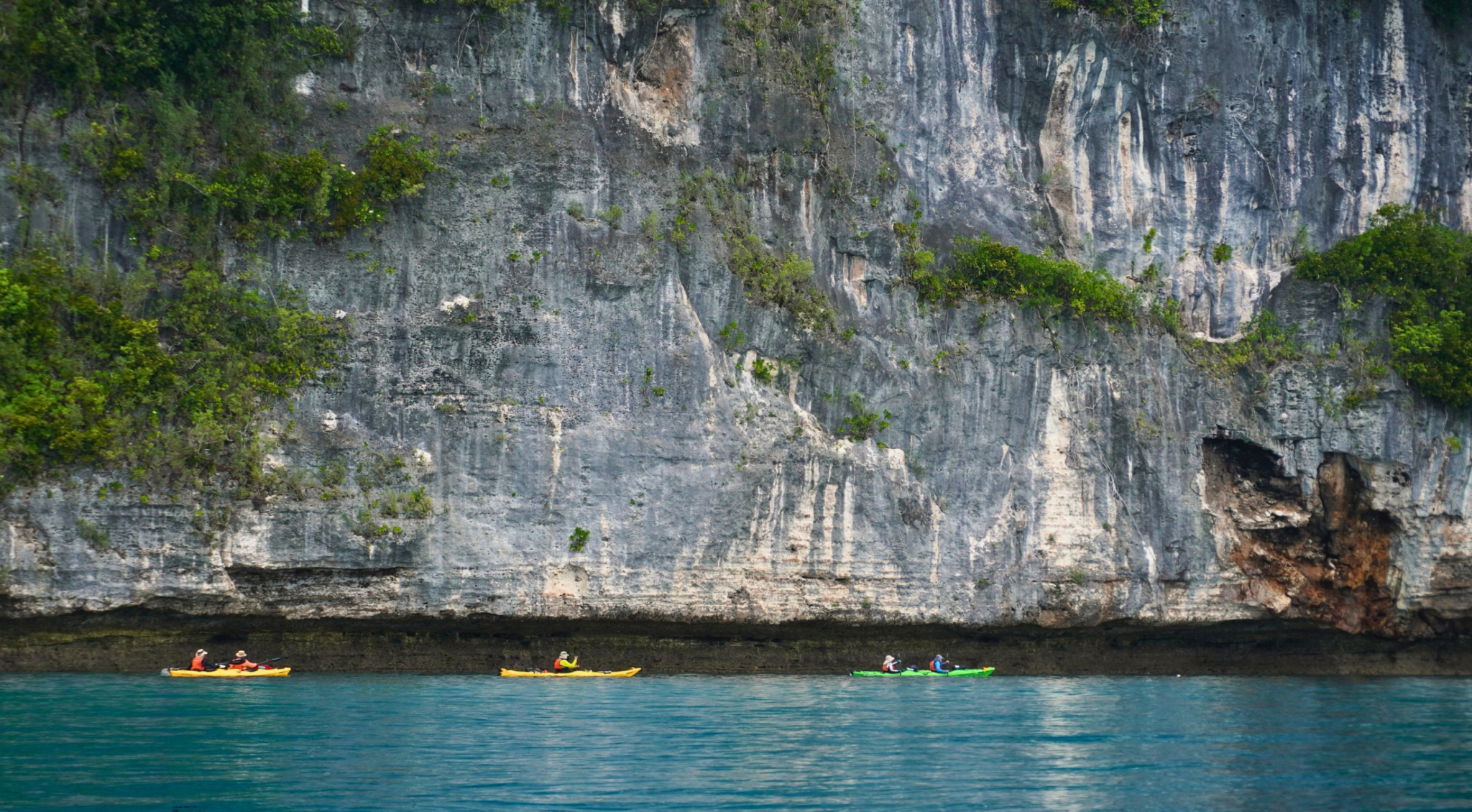
Our full day on Ulong is taken up by an exploration of its heart—a labyrinth of bays, lagoons, and channels. Each cliff wall is undercut by a couple of metres thanks to millennia of rising and falling tides and sea levels, making the smaller islets resemble giant, craggy mushrooms. Re-emerging into the ocean proper after a leisurely few hours of gliding over glassy lagoons and snorkelling among soft coral, we’re met by significantly higher winds and choppier conditions. For some, battling our way back along the coast is a challenge, but for me at least, the youngest member of the group, it’s more of a thrill.
After an uncertain start, the group dynamic is beginning to gel. I’ve deduced the nine of us cover all the personality types—the Mouse, the Grump, the Joker, the Medicine Cabinet, the Lapsed Hippy (aka the Punk Drummer), the Midlife Crisis, and the Queenslander. Oh, and the Undercover Journo (me). It’s also on Ulong that Mac really starts to emerge from his shell, proving there’s nothing he doesn’t know about the geology, flora, fauna, history or culture of his country. He shows us the fearsome-yet-beautiful fish poison tree, takes us on a tour of the archaeological remains of Ulong village, points out the rusty-capped kingfisher and the megapode, and even swims out to spear us some exotic fish for dinner.

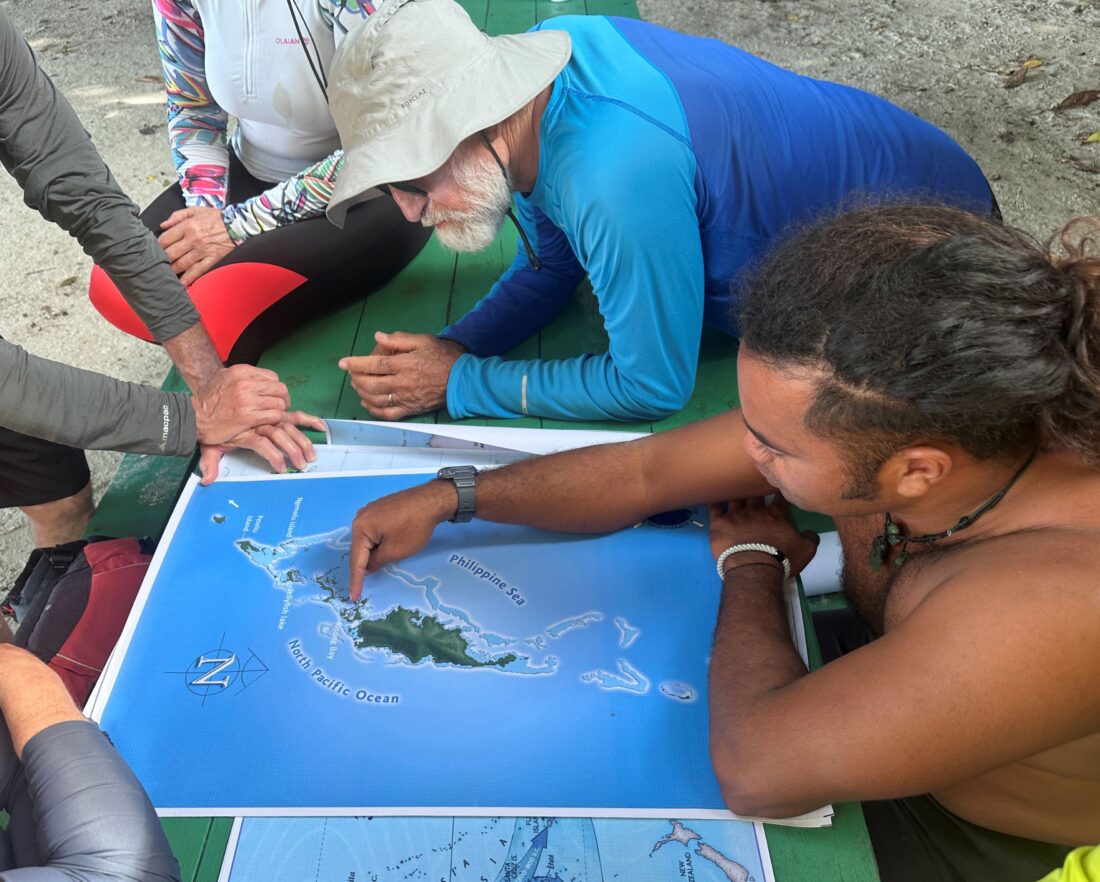
Then, in the morning, he pulls the end off what I’d thought was his personal poo-tube and fishes out a sheaf of beautiful maps.
“What do you guys know about … human history?” he asks.
Evaluative glances pass between us as the question hangs there, aloof in the morning sun. We sense it’s rhetorical, but we don’t wish to imply ignorance by staying silent. Just as I’m about to say something wholly inappropriate, Mac proceeds to school us on the waves of human migration that populated Micronesia, Melanesia and Polynesia. We walk away suitably upskilled.
Mac’s morning talks slowly become something of a highlight—open questions used as a springboard from which to educate us on, eg the nation’s strategic importance during the war, the intricacies of the three types of Palauan inter-tribal warfare, or the role of local quartzite quarries as the source of the giant stone currency of Yap, 2,000km to the east.
AT 7° NORTH OF THE EQUATOR, the current water temperature is around 27°C, while the air hovers around 21-23°C, year-round. [I immediately picture a group of bent, snow-haired Palauans sitting around an umukai earth oven, reminiscing about the fearsome cold snap of ’57, when temperatures plummeted to 19°C.] June is something of a shoulder season. While intermittent cloud cover makes for more comfortable paddling, the islands are swept by frequent squalls, although miraculously only once or twice are we clipped by the corner of a passing shower.
We’ve just crossed the channel between Ulong and Ngebedangel on Day Three when one rather large cloud bursts. Fortunately, we’re within lunging distance of a roomy cave with a tiny natural ‘indoor’ harbour—perfect parking for our kayaks. Chris and Mac throw together an early lunch while we watch the raindrops stippling the ocean outside.
“I wonder how many Japanese soldiers ate their lunch in this cave,” ponders Chris.
The Pacific’s most famous ‘lost soldier’ was Hiroo Onoda, who hid away in the Philippines until 1974, believing the war was still ongoing, but Palau had their own band of holdouts. Lt. Ei Yamaguchi and 32 compatriots only surrendered in early 1947, the last remnants of the 10,000 Japanese who died during the fierce battle of Peleliu.

An hour or so later, we glide into the beautiful turquoise lagoon at Ngchus, walled in by jungle. Wreckage from a Japanese Zero fighter plane—here a wing, there a fuselage—rests a few metres beneath the still surface. And beyond the camp shelter, wartime stores—thick-walled concrete bunkers with holes the size of sunfish blown through them—occupy the flat ground.
On tonight’s menu—needlefish. These were traditionally caught using a palm-leaf kite trailing a sticky rope of collected spider web which dragged in the water, attracting and entrapping the curious surface swimmers. Ingenious. Mac’s speargun is quicker, although on one occasion it takes him a couple of hours to return; when he does, though, it’s with a bounteous catch dangling from his belt. Someone jokes that, having had no bites, he probably swam all the way back to the fish market at Koror so as not to disappoint us.
It’s on Ngchus that Bede asks about my on/off limp, curiosity mixed with concern. I’ve been anticipating this and claim stiff limbs from a day in the saddle. He doesn’t pursue it, which I appreciate, but the problem becomes more obvious as I pace the camp before dinner, left leg twitching every thirty seconds. I blame Restless Leg Syndrome, which is only half the truth, but evade further discussion as I hate admitting the existence of an enfeebling health issue, even to myself. The RLS is usually controlled by medication, but being out of my routine has caused missed doses. I’m lucky it hasn’t so far broken out while in the kayak; such is the violence with which my legs sometimes spasm, I can imagine capsizing the thing by kicking it over from within.

OUR FREQUENT SNORKELLING STOPS ARE often rewarding, and visibility is usually very good. On one occasion (unfortunately shared with thrashing daytrippers in life jackets) we see giant clams, some as large as a metre across. Their mantles (ie their ‘lips’) glow vibrantly from the seabed—rich purple, taupe and deep rust, the hue determined by the algae that live on each one. Chris freedives down to an empty shell to recreate a classic Boys’ Own Adventure image—a skin diver running out of air, one fin caught in the vice-like grip of a monstrous bivalve.
On other underwater excursions, I spot a flowery flounder glaring at us from the top of its head; a shoal of wonderfully named yellow-tailed fusiliers (I imagine a company of them charging the Russian guns at Balaclava); and pairs of surgeonfish whirling in circles nose-to-tail, like flashing Catherine wheels. However, nothing beats coming face-to-face with a shiver of sharks just off the beach at Ngermeaus. Chumming the water with the day’s fish guts, Mac lures eleven black-tipped reef sharks into our orbit, and we watch in awe as their perfect bodies slide around us, mouths slightly open in that semi-hungry/semi-gormless way they have.
Mac informs us that four of the sharks are pregnant females likely to give birth this very night, timing their expulsions with the full moon. We’d seen small packs of baby sharks patrolling the shallows each morning, last month’s crop, most likely.
While the snorkelling is good, I’m never happier than when kayaking, alone or in perfect sync with a partner. From lagoon to rock arch, from overhang to leaning stack, the scenery is outstanding; the Rock Islands of Palau should be ranked right up alongside Ha Long Bay and Raja Ampat. By the end of the week, I’m trying to cram in as much action as possible, all too aware of a future in which waking up on a deserted beach and jumping straight into a kayak will be a lot harder. On the other hand, I won’t miss carrying around half the Gobi Desert in my boardshorts, or miss living a life of perpetual dampness. My phone has spent so much time in a bag of rice (in order to suck up moisture within the device) that it’s developed a new warning: ‘Rice detected in charging port’!

On the penultimate afternoon, as the rest of the group are setting up tents, I persuade Chris to accompany me out to the outlying Beab Islands, a row of stacks two kilometres to the east. It feels great to really open the shoulders and plough toward a distant objective, focussed on my technique—core engaged, torso swivelling, feet securely braced. We thread a couple of the stacks and head straight home as Chris has to help prepare dinner.
It’s a bonus paddle but I’m still thirsting for more, and after we disembark for the last time the following day, I slip out again, alone this time, unable to resist the small island opposite our camp. I cruise slowly around it, taking my time, gazing up at the sooty-headed terns and fruit bats, their leather wings flashing translucent as they glide before the setting sun.
As I round the final bluff to see my new friends cracking open a surprise bottle of wine, I feel a sudden rush, a dopamine high I last felt standing atop a high peak. In fact, the urge to encircle any kind of small island has had that familiar irresistibility. The realisation dawns—I’ve discovered the kayaking equivalent of summit fever! Islets, rock stacks, cays, skerries, atolls—circumnavigation is the new peak bagging, disobedient legs be damned! Life just took an upturn.
CONTRIBUTOR: Dan Slater, a lifelong bushwalker, is a fifteen-year veteran in the retail sector. He keeps forgetting, losing, breaking or drowning headlamps, and is thinking instead of mounting a candle on his head. Dan paddled in Palau as a guest of Southern Sea Ventures.
If you liked this piece, you should subscribe to the print mag. Only a fraction of the great stories we run in the mag make it to our website; if you want to read them, head to subscribe.wild.com.au