Coast to Coast
Billy Macfarlane rounded up a couple of mates to set off on a crazy adventure: Be the first, as far as they knew, to packraft from Tassie’s north coast to its south. Little did they know just how insane their plan was.
Words and Photography: Billy Macfarlane
(This story originally featured in Wild #197, Spring 2025)
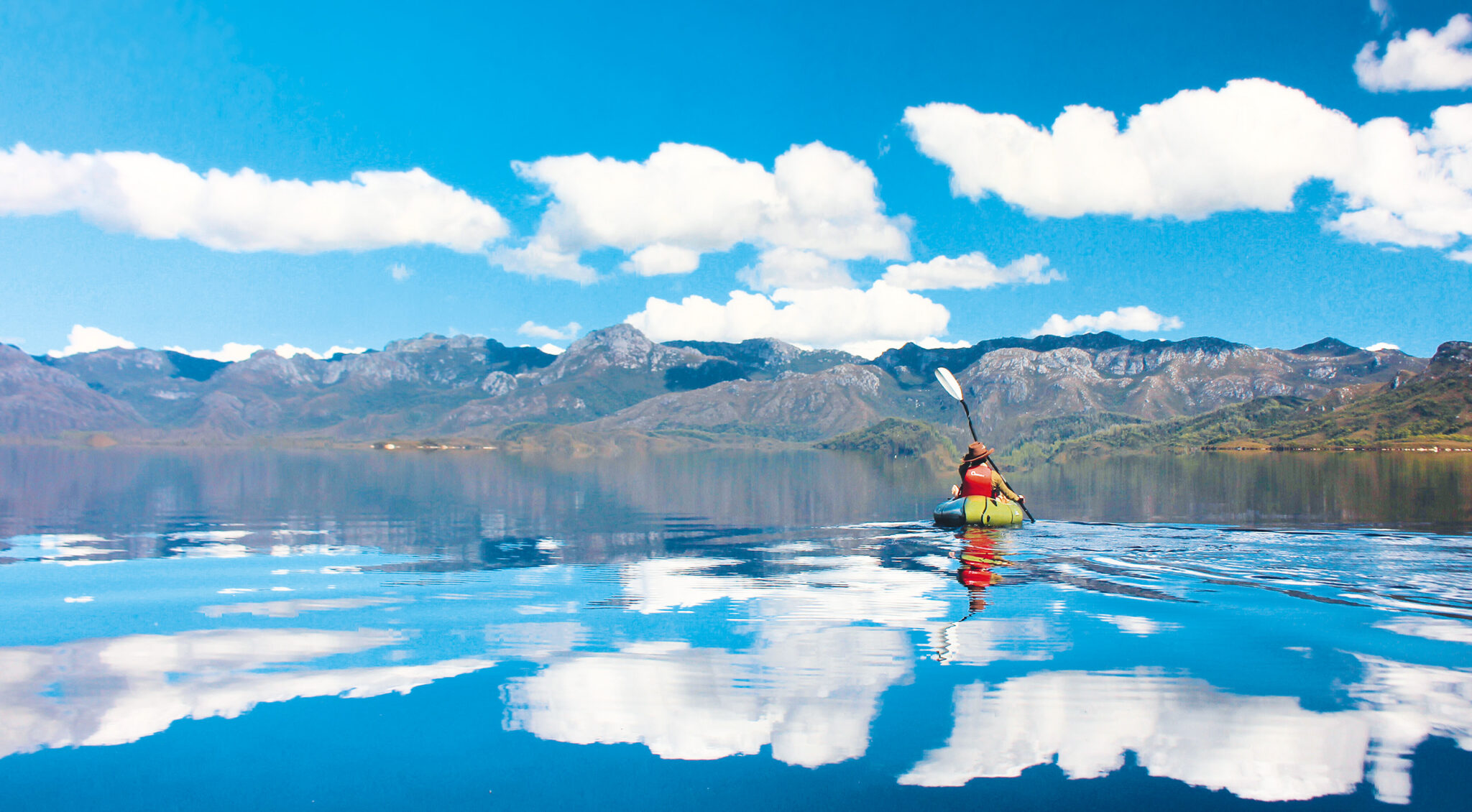
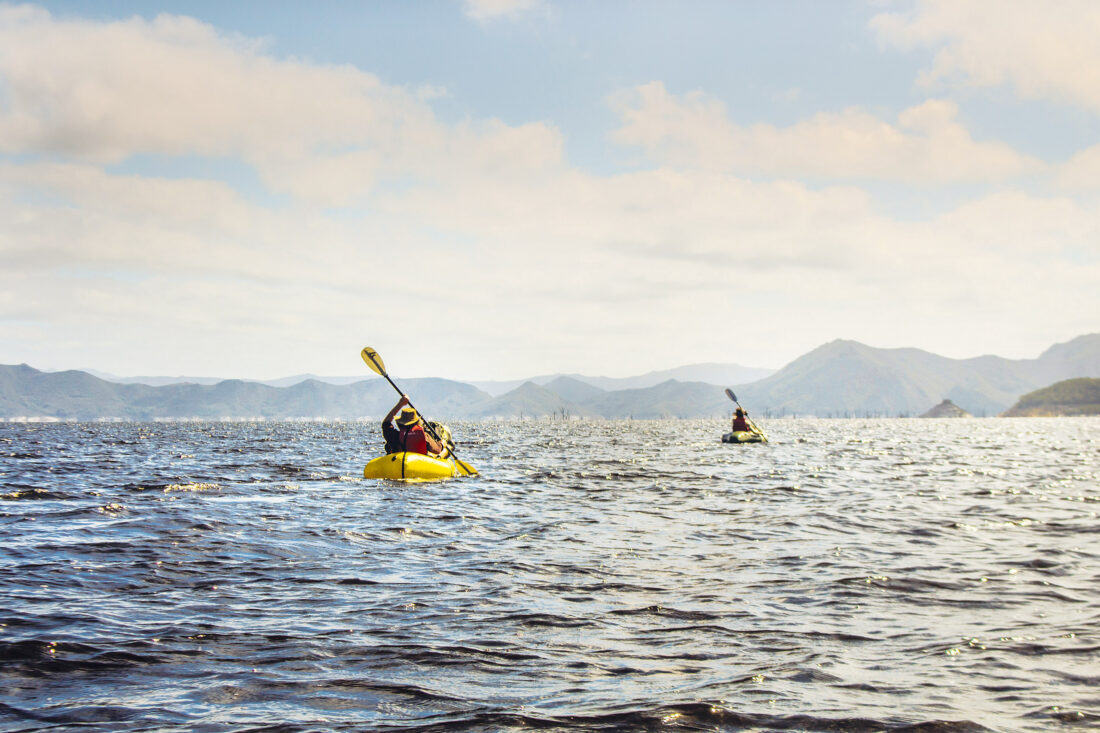
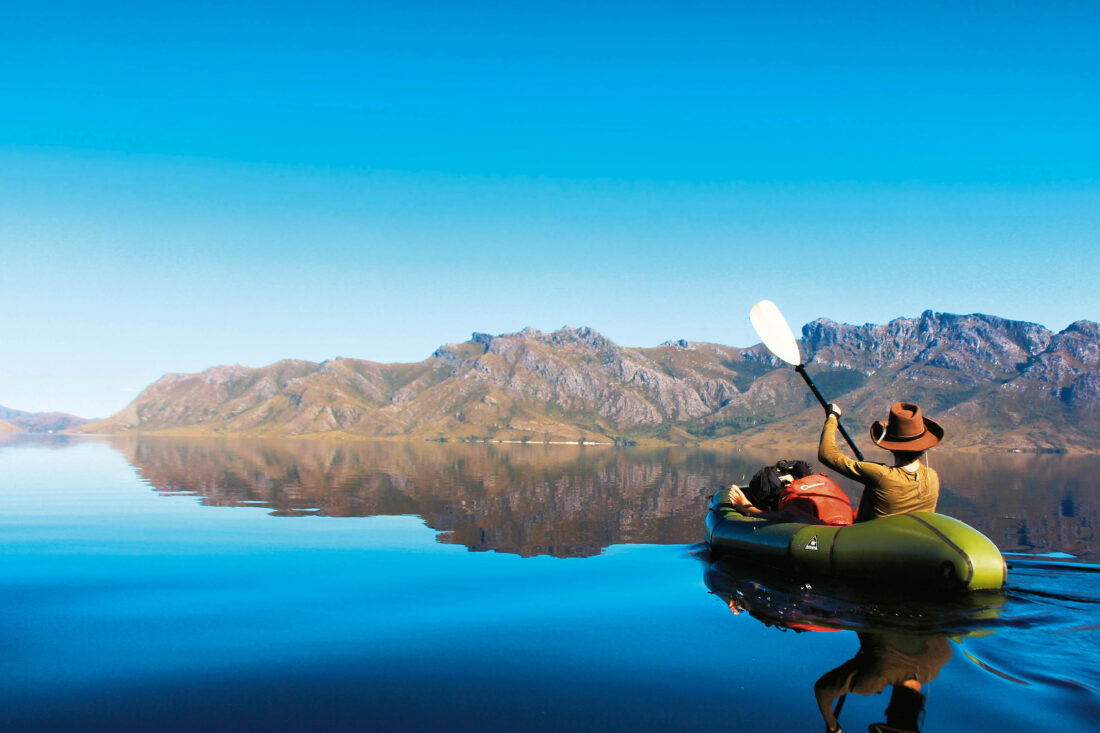
Banner image caption: Jim paddles across Lake Pedder in perfect conditions. If only the rest of the trip was this easy
Why did life first crawl from the primordial ooze and drag itself onto dry land? Well, I’m certain the answer is simple: Because it was there. What else could possibly have convinced our distant ocean-going cousins that swapping fins for legs and gills for lungs was a good idea? Sure, evolving an entirely new way of breathing and moving is a lot of effort to go through, but I can’t think of a better reason to do something than the simple fact it is there. At least, that’s what I told my mates as I was pointing to a map of Tasmania and trying to justify why we should venture across the entire island.
Two months later, as we hunkered under our tarps, the rain forcing its way through the ember holes and tears in these thin sheets of plastic, I reminded them of this point. It did occur to me, though— as we savoured each drop of our instant miso soup which had been our breakfast for the last three weeks—that I had bloody suggestible mates, and they should probably have put up more of a fight.
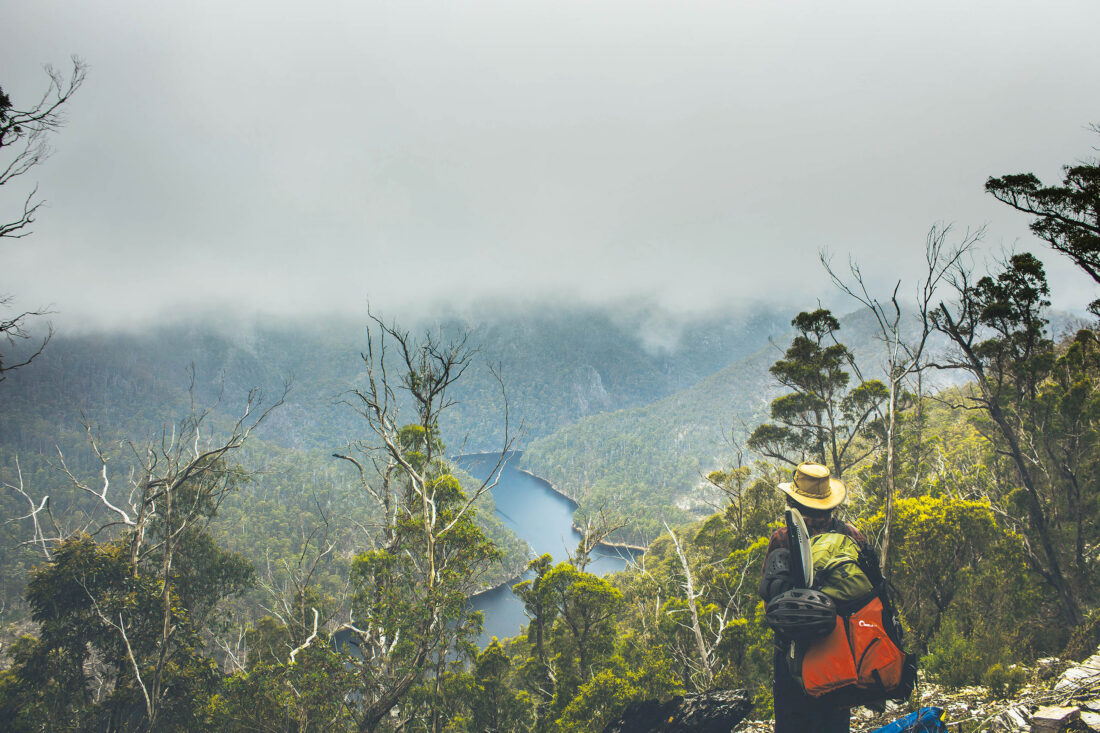
Somehow, I’d got it in my head that it would be possible to canoe across the island by paddling from the north coast, portaging over a few mountains, crossing the great lakes of the Southwest, and then following more rivers out to sea. After a bit more Google Earthing, I figured portaging a 20kg Canadian canoe might be extreme; a packraft, however, would be the perfect vessel—small and light enough to carry with a rucksack, but once inflated, big and sturdy enough to carry a human plus gear down rivers, across lakes, and through rapids. A magnificent invention, just the thing for an expedition across Tassie.
Enlisting my mates Jimmy and Nick was the next challenge, although once I’d explained the bit about the primeval sludge, they were sold. Due to work commitments, Jimmy was going to meet us roughly halfway, so Nick and I flew over first, rented a car, and buried some food drops along the route.
Nick also had to meet a bloke named Matt in Devonport who was selling a Kokopelli raft on Facebook. It was the raft he planned to cross the island in over the next five weeks. I thought it concerning that we were leaving it to the day before we set out to pick up such a vital piece of equipment, but anyway, we went round to Matt’s house.
Once there, he had something to tell us. He said it almost casually: “I’ve lost the inflation bag.” Not ideal, we thought; without a bag, it’s very hard to turn a packraft from a bit of plastic into a boat.
“Nah mate, no worries,” said Matt. “I’ve got this. It’s an inflation tube; it’ll do the job.” He produced a foot-long, clear tube from his pocket. “Just screw this on, blow into it, and she’ll be right.”
Right. We didn’t have much choice; there aren’t any Kokopelli packraft retailers in Tasmania, let alone Devonport. So Nick bought the raft, we returned the car, and plodded off to the beach.
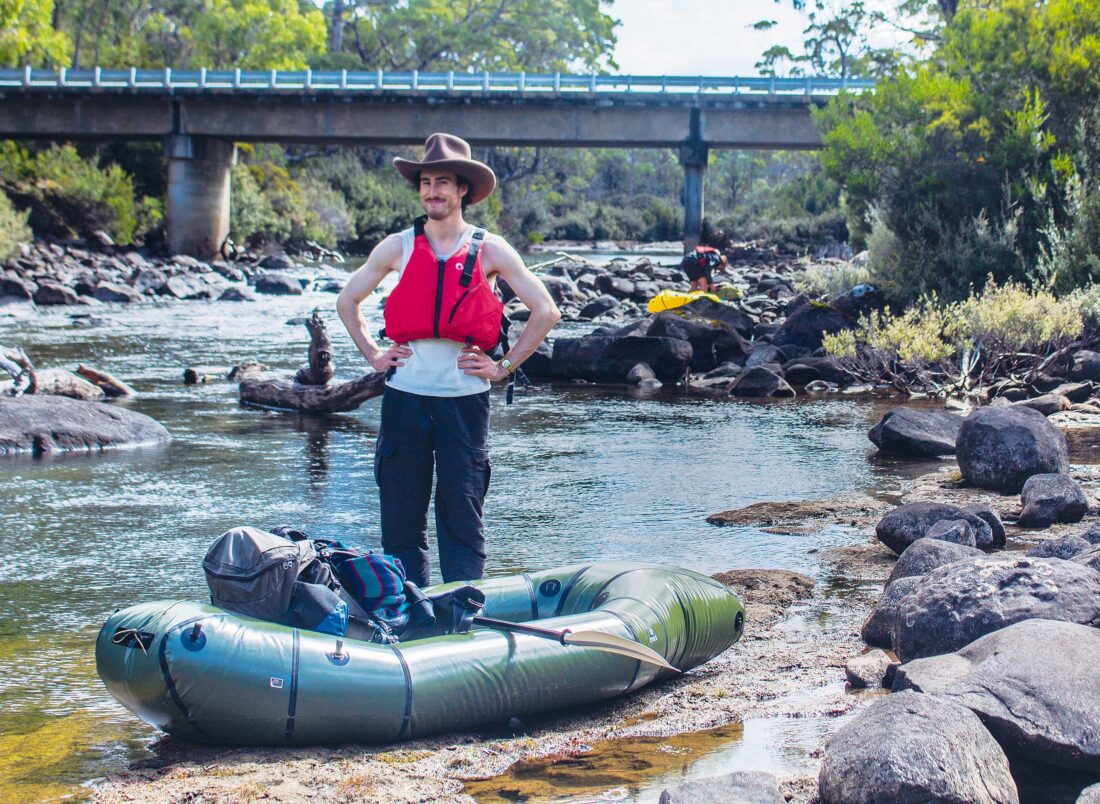
Soon we stood at the mouth of the Forth River. I inflated my Alpacka raft in about five minutes; Nick fiddled around with his tube for half an hour. Once he was done, we jumped in our rafts and set off to cross the island.
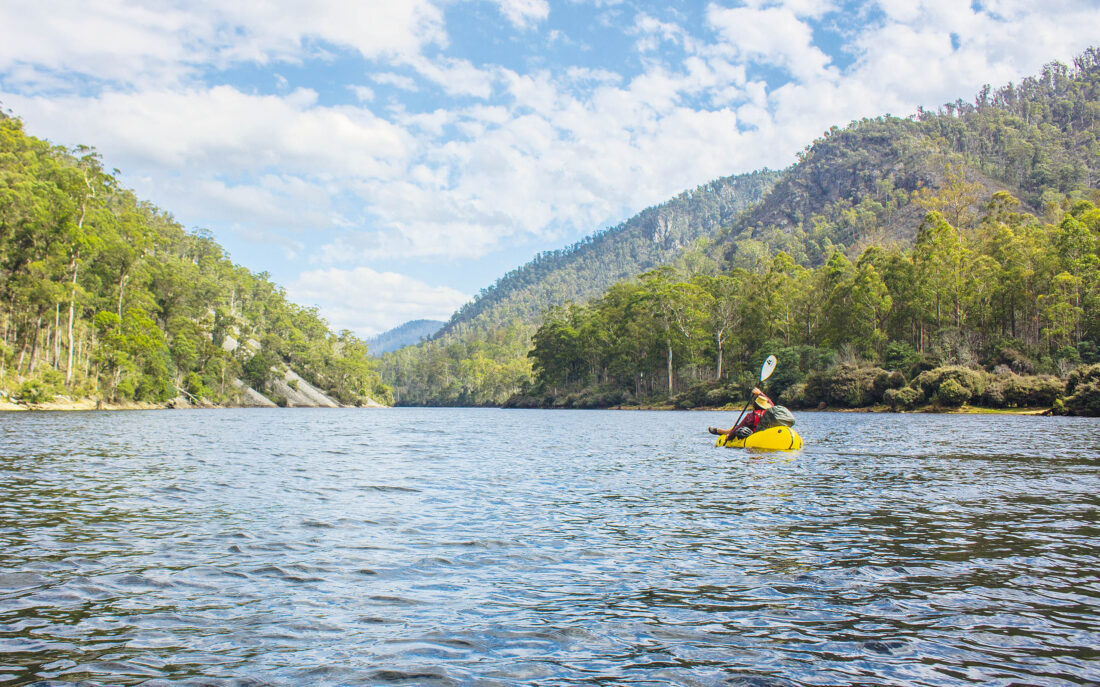
For the first few days, the river was predictable. On approach to each dam along the river, we paddled upstream as the water level dropped. Once we reached the big slab of concrete impounding the river (and our progress), we portaged our rafts, threw them back in the nice, plump lake on the other side, and enjoyed hours of steady paddling until the lake became the Forth again and the process repeated. In similar fashion, we crossed the Paloona, Barrington, and Cethana Lakes/Dams in decent time.
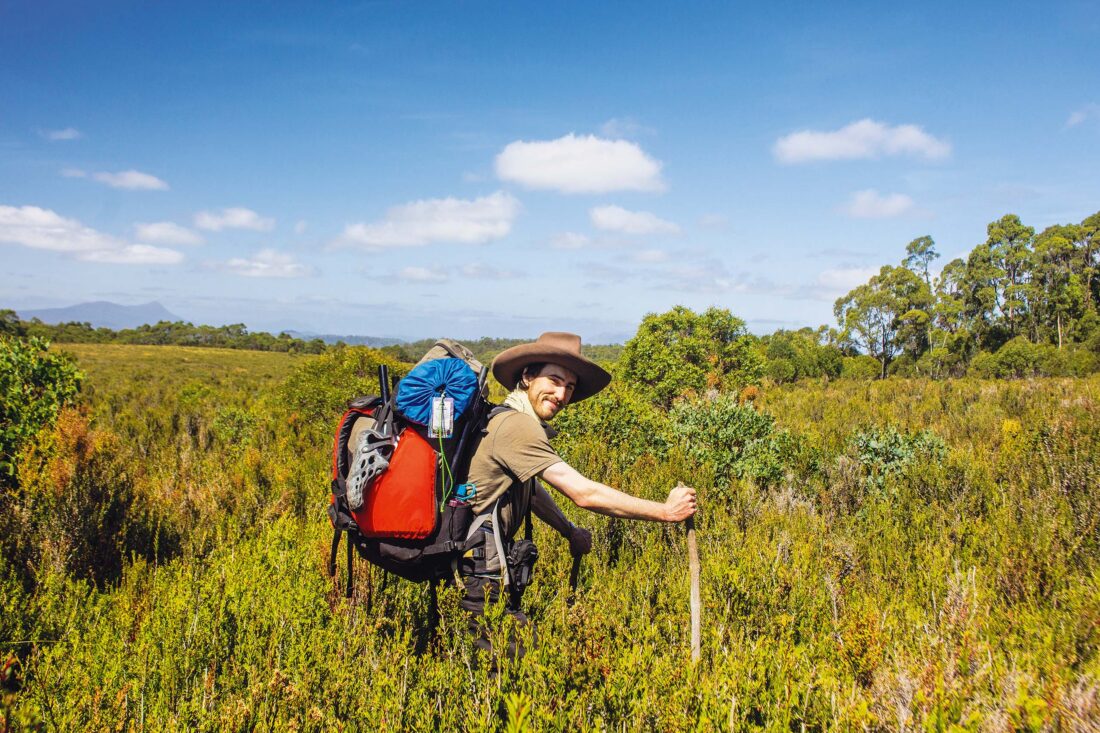
Our first food drop was near Lake Parangana, part of the Mersey River hydro system and in a parallel valley to the Forth. After bashing up a heavily vegetated hill and descending a break-neck slope, we trudged along a tarmac road towards where we’d dropped off the food just days earlier.
“Do you remember where we buried the food?” asked Nick, as we approached the shores of Parangana. “I swear the water level is higher than it was a few days ago.” He was right. The water had indeed risen, and the decision to bury our food in the soft soil on the shore of the lake suddenly seemed like a bad idea. We dropped our bags and ran down to where we buried the food drop, and although it was thankfully not yet underwater, it was damper than it had been. We dropped to our knees and clawed at the ground until our nails scraped plastic and we heaved our bucket of food from the earth.
As I sat at camp that night, munching on pork scratchings, my eyes drew opposite me. Nick was laying against a tree, his legs extended straight ahead of him. Looking down, I saw the soles of the boots he was wearing, or rather, the lack of soles.
“Mate,” I said. “I can see your socks! Your toes are poking out the bottom of your boots!” I was in sheer disbelief that he’d not only been hiking for days in such decrepit shoes, he planned to continue in them for the foreseeable future.
“Yeah, I didn’t notice at the start, but they’re a bit knackered, hey,” said Nick, clearly a little too unbothered. “Shoulda brought some duct tape for them.”
“You need a lot more than duct tape for those, mate. Why don’t we text Jim to bring you a pair of trainers?”
“Nah, I need to be there if I’m getting new shoes. Can’t have any old pair, they might not fit properly,” replied Nick. I advanced that any pair of shoes is better than essentially no pair of shoes, but he was adamant that these boots would see him through. He’s already gone mad, I thought. No use trying to convince him.
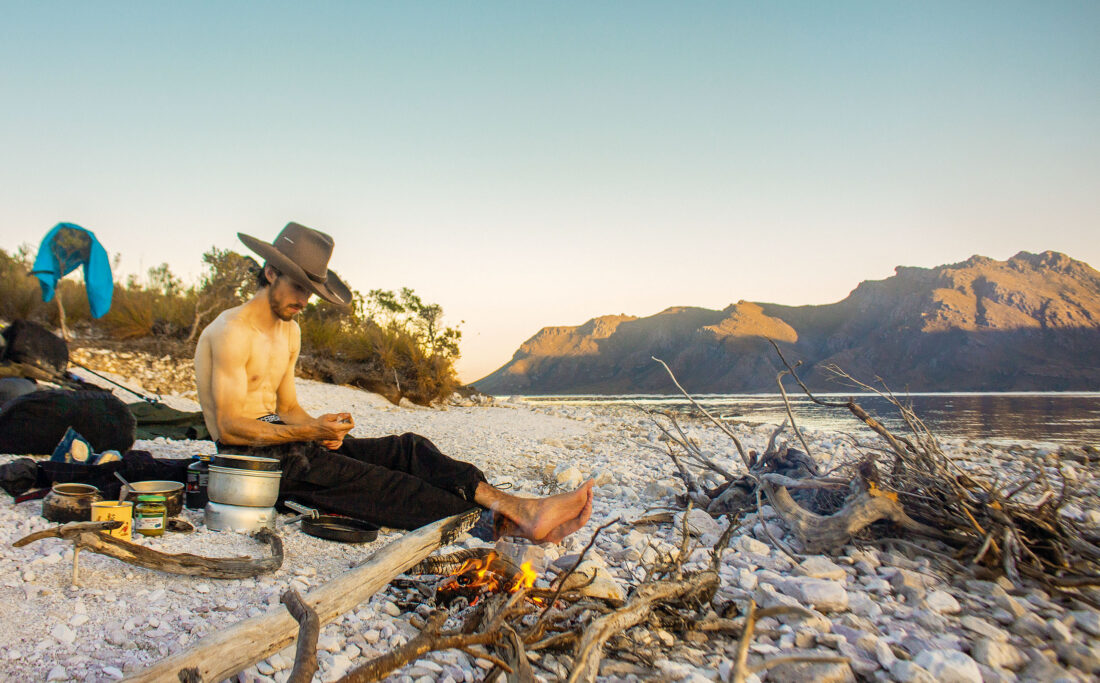
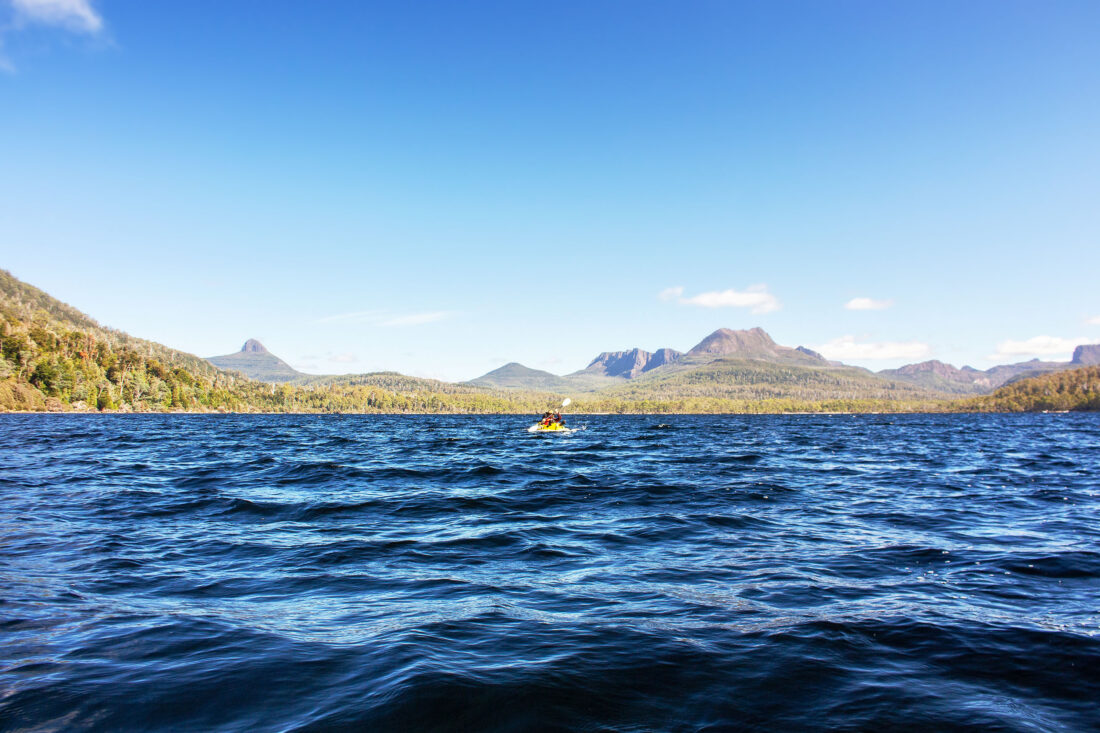
The next few days passed in a haze of eating an appropriate amount of calories and of reaching the upper limits of the Mersey River. We deflated our rafts and headed into the mountains of the Cradle Mountain-Lake St Clair National Park. A vague trail led up to the Overland Track, which was like a highway compared to the bush bashing we’d be doing. Once at Lake St Clair, a tailwind had us cruising at a fine pace across the only naturally formed lake we’d paddle on the entire trip. We reached the shore beneath the visitor centre, and like a scene out of a Paterson poem, a bloke in a singlet was leaning against a tree with an Akubra over his brow. He lifted his head, reached into an esky, and dug out two cans of Coopers.
“You boys look like you could use these,” he drawled. His assessment was correct. We bestowed our gratitude on the jolly swagman, rolled up our rafts, and wandered off to find Jimmy at the pub in Derwent Bridge. He hadn’t brought new shoes, but he had brought stacks of dehydrated food he’d been busy cooking up over the last two weeks. He also had a bottle of Wild Turkey, which we dispatched that night in the revelry of reunion.
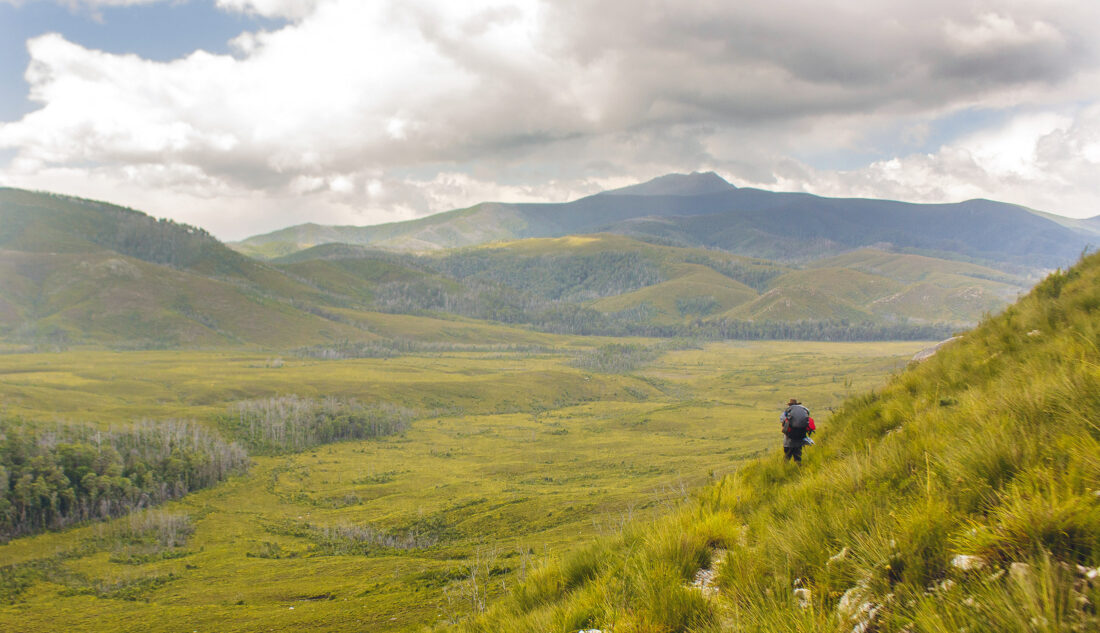
The plan was then to cross Lake King William and hike across the plains to meet the Gordon River, which we’d then paddle all the way to Lake Gordon. However, in our preliminary research, information on the upper Gordon River was scant. The word “logjammed” cropped up repeatedly at any mention of paddling the Gordon, but how bad could it be?
On our second night as a trio, we left the southern basin of Lake King William, and set up camp on the edge of a rust-coloured mud flat. I was just drifting off, swaying gently in my hammock, when I heard a guttural sigh somewhere off in the west. It grew louder, the air pressure dropped, and an almighty gust of wind ripped through our campsite. It tore our pegs out of the ground, our tarps flayed themselves in the air, and branches crashed from the trees around us. We spent the next few hours scrambling around in the gale, climbing in and out of our hammocks and retying the guy lines. The morning revealed the casualties: two torn tarps, a dozen tent pegs MIA, and a vanished sock. Nothing we couldn’t do without for two weeks in the bush.
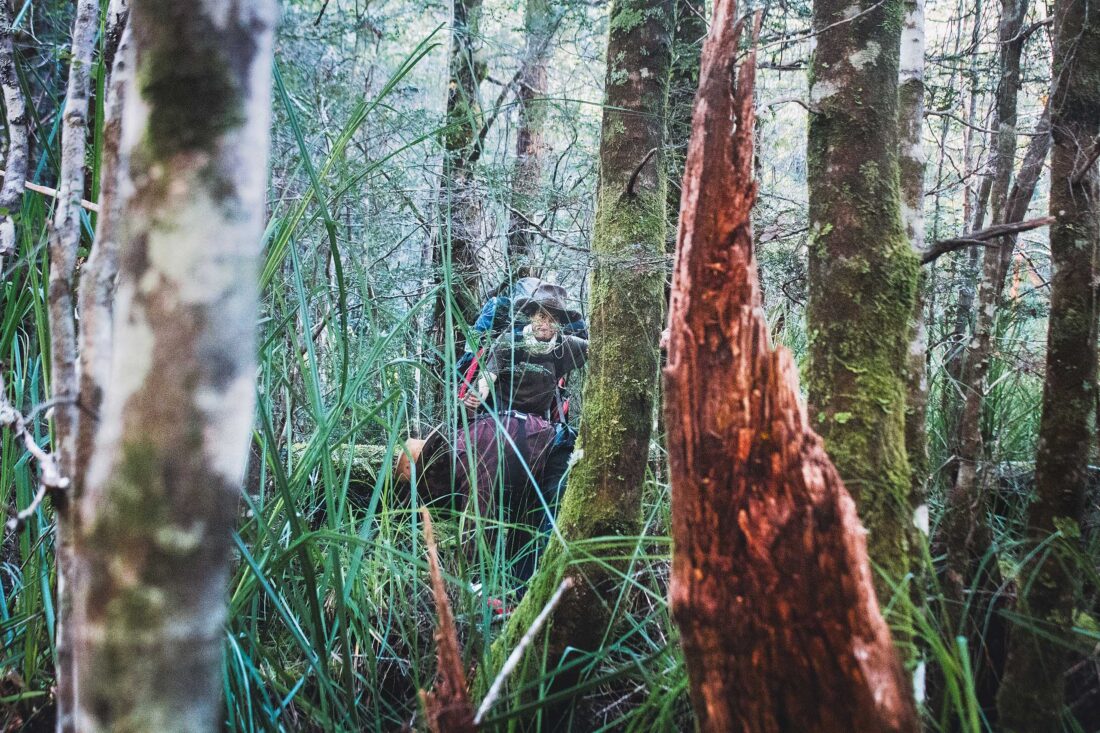
After assessing our losses, we trekked out into the buttongrass plain ahead. If you’ve never had the pleasure of walking through buttongrass, let me tell you what you’re missing. Imagine being unable to see the ground below your feet. With every step, you’ve got a fifty per cent chance of either sinking into a muddy hole or rolling your ankle on the round top of the buttongrass. If you’re lucky enough to end up in the mud, you then have to step back up onto the knee-high tussock, an exhausting task with a raft and a week’s worth of food strapped to your back. Rinse and repeat.
It’s a frustrating, slow way of making progress, but we were confident that the trickle of a mountain stream that would become the Gordon River lay a few kilometres ahead; from there, we could make swift progress on our rafts.
The next day, we were in exactly the same position as the day before. We tried to climb a hill rising between us and the river, but the bush was matted together like a stray dog’s coat; we spent the best part of the day trying to force our way through. We reached a plateau on top of the hill, but as we stood there under eight foot of scrub which showed no sign of easing, we made the call to turn around the way we came and risk our ankles in the buttongrass. If Dante had been Tasmanian, I’m certain a circle of hell would’ve been made from buttongrass.
After another day and a half of stumbling through endless tussocks, we heard the unmistakable sound of running water. We leapt from button to button, following the sound, threw ourselves into a grove of gums, and nearly fell down a cliff. There it was: the wild Gordon River, tumbling over a mossy precipice into a gorge, completely hidden from the world above like Tutankhamun’s tomb. We lowered our bags into the gorge with some rope and then climbed down ourselves, and, keeping the stream on our left, marched forwards with vigour. Before the end of the day, the stream had widened to the point we could stick a paddle in—it was time to get the rafts out.
“Ah, hold on guys,” said Nick. “Has anyone seen my tube?”
Our eyes briefly scanned the pristine bush for the only piece of plastic around for dozens of kilometres.
“Nah mate, no tubes around here.”
“Bugger.”
Because Jimmy and I both had Alpacka rafts, and Nick a Kokopelli, our inflation bags wouldn’t work with his; he was on his own. And with his inflation tube now lost somewhere in Southwest Tassie, he had to blow directly into the valve, squeezing air out of his lungs with enough pressure to force open the valve and inflate his boat. From then on, the poor bastard nearly gave himself hypoxia every time he wanted to get in his raft.
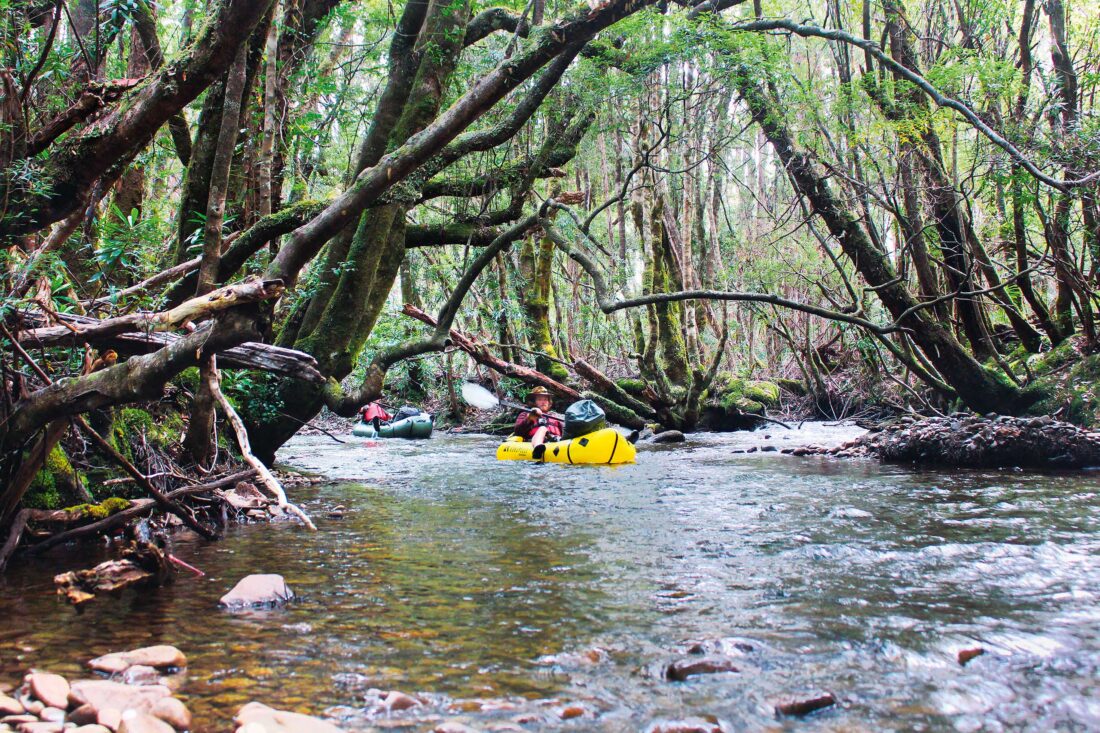
Once Nick recovered his breath, we threw our bags in the boats and our bodies followed suit. As novice paddlers, the rapids that lay in wait were above our paygrade. We shot over ledges, plunged through slots, and slammed into logs as we barrelled down the river. We had as much control as a pinball in a blender. Eventually, we jammed ourselves into an eddy, hauled our rafts onto a ledge, and spread out on the mossy banks of the river, delighting in this untouched wilderness as the adrenaline from the cold water and paddling wore off.
The next day, the canopy above us opened as the kombucha-dyed river widened, and we emerged from the pocket of ancient rainforest into a flat valley. We could see the tufts of buttongrass stalking us on the banks, watching and waiting.
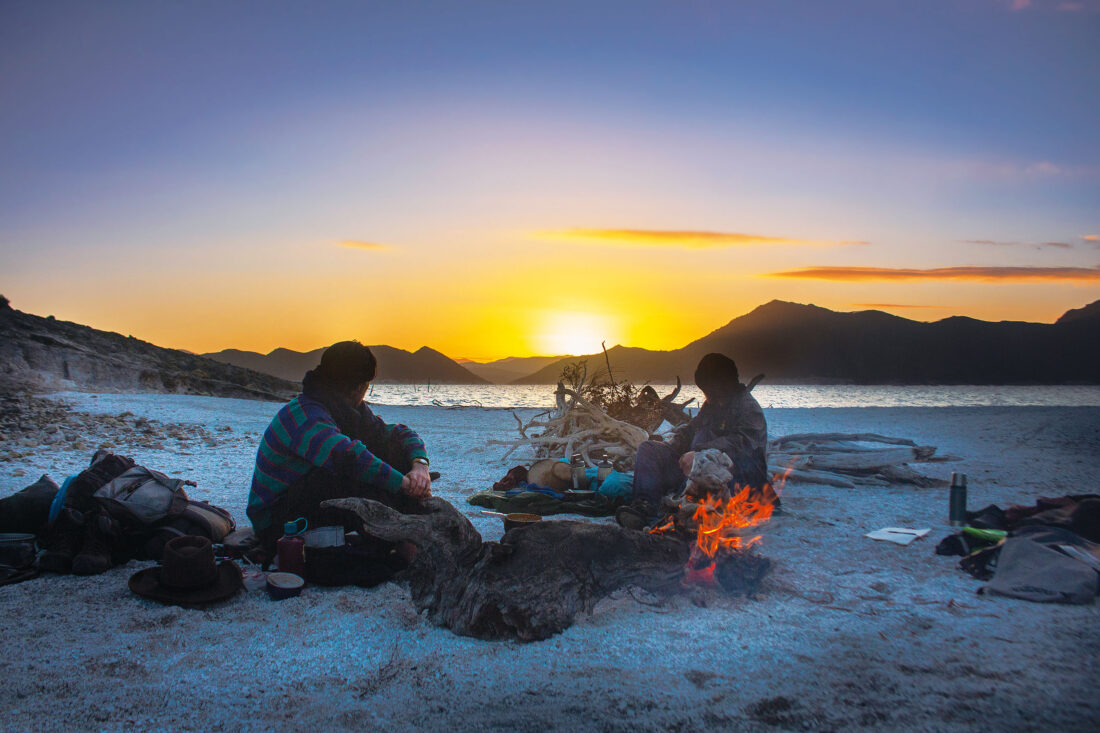
“Glad we’re not walking through that again!” I shouted merrily to the lads, reclining as my raft drifted easily downstream. A kilometre later, we encountered a tree trunk spread across the breadth of the river. No worries, we said, it’s easy enough to climb over. We got out, dragged our rafts over the log, and started paddling again. Fifty metres later, the same thing happened. Then we got twenty metres before we had to get out, only to see that the entire river ahead of us was filled with logs, each about five metres apart. Too far to walk between, but too close to make paddling anything close to efficient. We tried, but after a full day of portaging around logs and hoping that the river would open up again, we only travelled about two kilometres. Around the campfire that night, we discussed our options and checked our maps. We decided that the hateful logs disrupting our progress were worse than the hellish buttongrass, so we deflated our rafts and planned to walk downriver until the logs relented.
An entire day of falling over buttongrass resulted in us finding the river even more logjammed than before, so we kept walking for another day. At this point, we realised we’d misjudged our rations completely. Our breakfast was an instant miso soup; chosen for lightness and cheapness, it was decidedly low on calories. Lunch was a spoonful of peanut butter, more filling than the miso, but still not quite enough. Dinner was better. We could feast on one of the dehydrated meals we’d made before we left, which was either the choice of curry (delicious) or a mung bean and mushroom stew (not so delicious), served with couscous. Again, we hadn’t quite made enough to feed three people rapidly burning through calories, and our minds became twisted with thoughts of food. Each day, we’d run through all the things we’d eat when we escaped, with a strong emphasis on cakes, with buttered toast a close runner-up.
Another day of walking saw us meet the river in a better state; the Gordon had finally settled into a sensible, log-free river. Elated that we could leave the pesky buttongrass behind, Jimmy and I inflated our rafts while Nick tried to remain conscious, and we were soon back on the river. We rounded a bend, floated through gentle rapids, paddled around a horseshoe, and came upon a 16-metre-high wall of logs. I’m no botanist, but I suspect we were encountering the hulks of ancient Huon pines, renowned for their rot-resistant properties. They’re magnificent trees, but I was wishing that the bloody things would decompose right there and then.
Climbing over the logjam revealed another massive dam downstream. At this point, exhausted and distrustful of the river, we’d had enough. We gave ourselves over to the buttongrass, and crossed the Vale of Rasselas on foot until the Gordon emptied into Lake Gordon. It took five days of steady, tedious hiking across the buttongrass—subsisting on meagre rations—and a desperate climb up and over the alpine reaches of the Denison Ranges before we made it to Lake Gordon’s shores.
We had just one day to complete the 20km lake crossing. Likely to be paddling into the prevailing westerlies—not ideal in our blow-up rafts—we steeled ourselves with a final mung-bean dinner, and set off at 5AM. Fuelled purely by the promise of our food drop waiting at the Strathgordon Hotel, we pushed ourselves beyond any limit of exhaustion that we’d known. By 4PM, we were walking to the lodge’s front door. There, we came face to face with a sign: Closed until further notice. Since we’d left our food with reception inside, this was bad news.
Eventually, we found a staff member; presumably taking pity on us, he let us in. We each bought six Maxibons each, and every single sandwich and cake they had left in the kitchen. Then we sat outside and devoured the lot. The manager then came by; after hearing where we’d come from, he gave us a glass of whiskey each and access to the showers. In an instant, our hardened explorer instincts were shattered. We all just wanted to be done with the expedition.
Jimmy and I were just being soft, but Nick was actually broken. His lack of functional footwear had destroyed his feet, his rucksack was falling apart, and his raft was such a pain to inflate that it compromised the advantage of having a packraft at all. So, while Jimmy and I elected to carry on, Nick made the difficult decision to hitch a lift out and head home.
Hindsight truly is remarkable, because the rest of the trip couldn’t have gone better. We crossed Lake Pedder in two days in the stillest conditions ever seen in Tasmania.
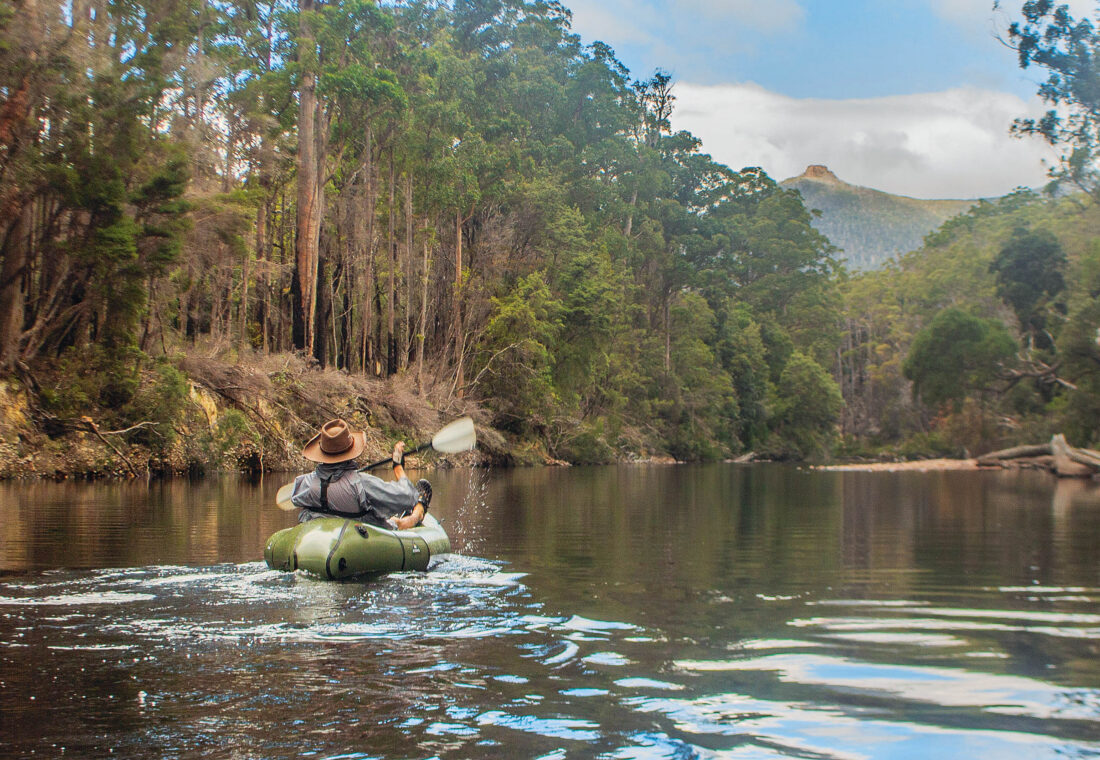
Once we reached Edgar Dam, we followed hiking trails until we reached the Cracroft River, which spewed us into the Huon. A couple of days of paddling down that lazy river, and we reached Huonville, where we dipped our hands in the water, and tasted the salt.
We’d made it to the South Coast, and as far as I can tell, became the first people to cross Tassie north-to-south on packrafts. It’s amazing what instinctual impulses can make you do.
If you liked this piece, you should subscribe to the print mag. Only a fraction of the great stories we run in the mag make it to our website; if you want to read them, head to subscribe.wild.com.au