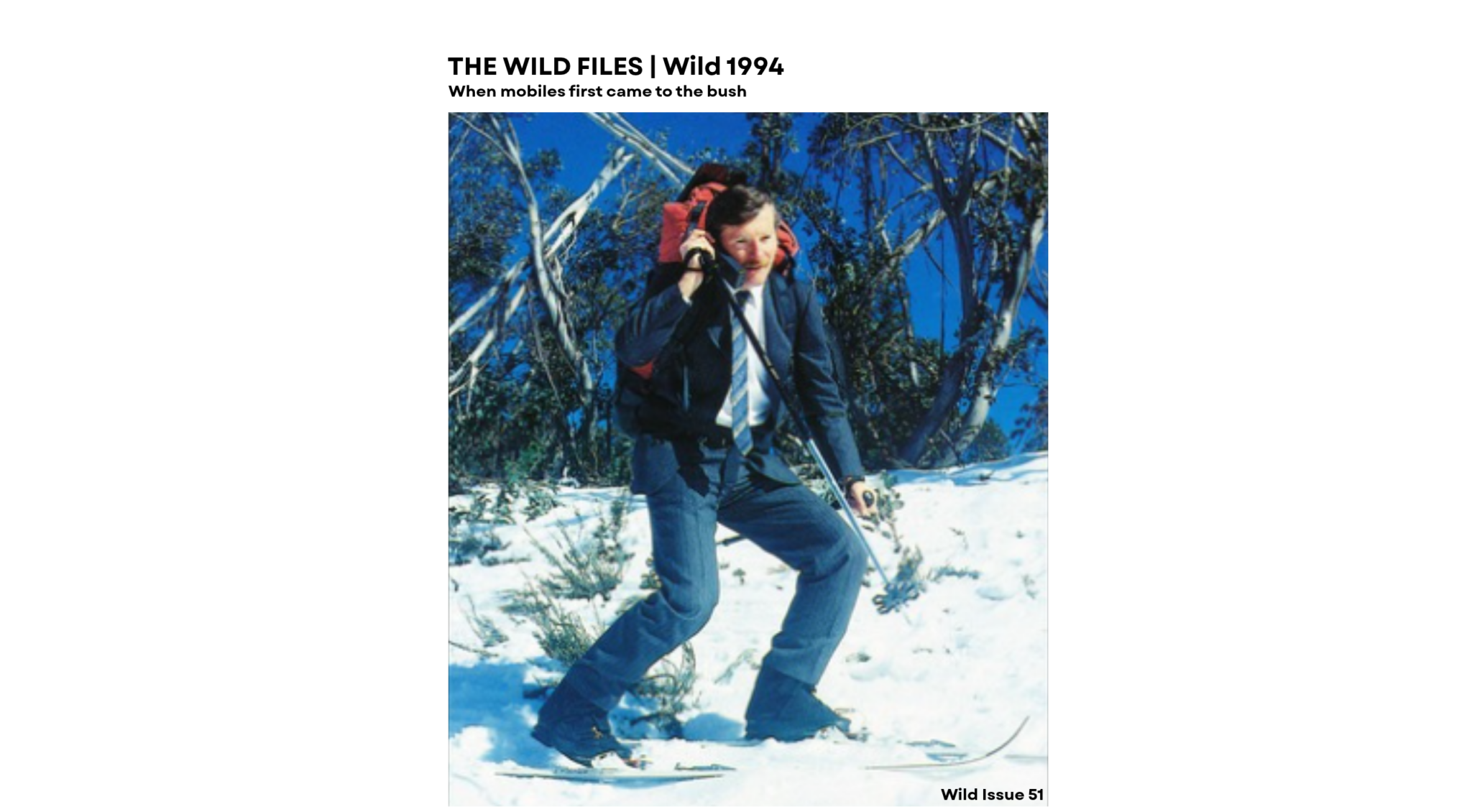

The Wild Files: Yuppie Walking (Extract)
(This story originally featured in Wild #51, Summer 1994)
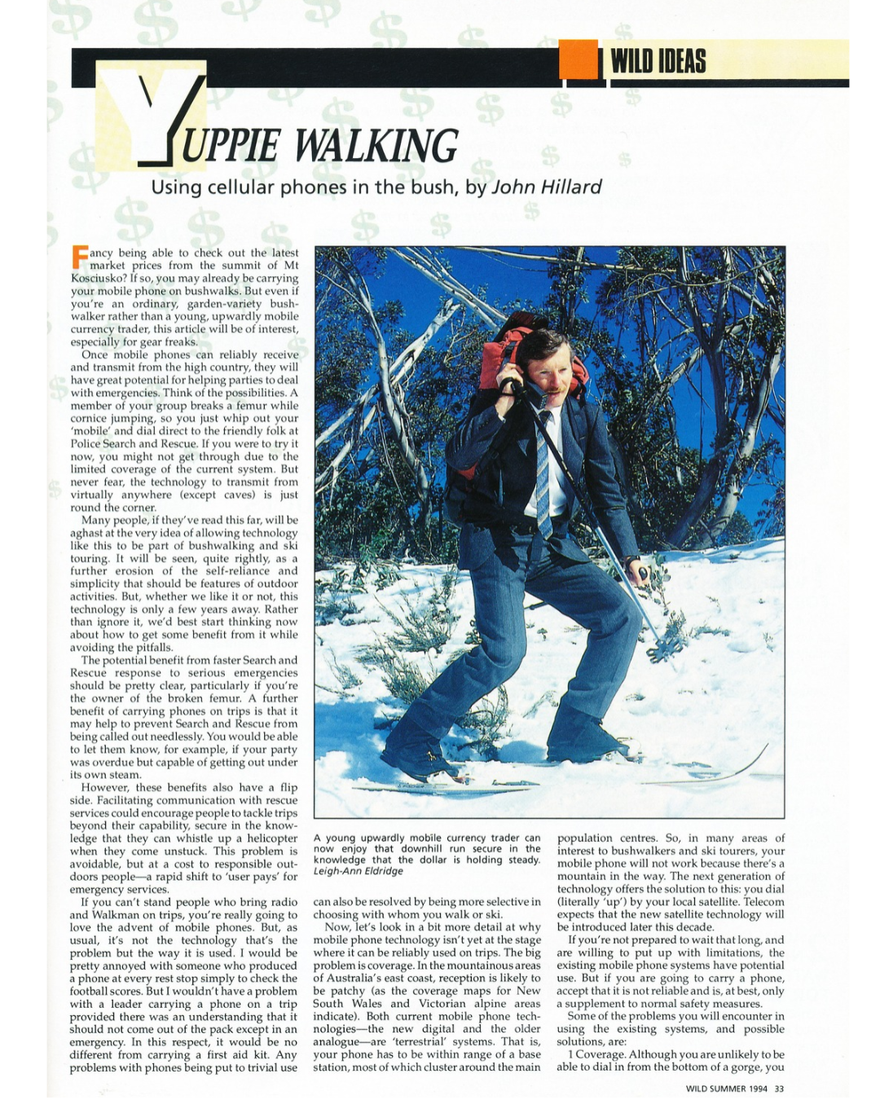
Fancy being able to check out the latest market prices from the summit of Mt Kosciusko? If so, you may already be carrying your mobile phone on bushwalks. But even if you’re an ordinary, garden-variety bushwalker rather than a young, upwardly mobile currency trader, this article will be of interest, especially for gear freaks.
Once mobile phones can reliably receive and transmit from the high country, they will have great potential for helping parties to deal with emergencies. Think of the possibilities. A member of your group breaks a femur while cornice jumping, so you just whip out your ‘mobile’ and dial direct to the friendly folk at Police Search and Rescue. If you were to try it now, you might not get through due to the limited coverage of the current system. But never fear, the technology to transmit from virtually anywhere (except caves) is just round the corner.
Many people, if they’ve read this far, will be aghast at the very idea of allowing technology like this to be part of bushwalking and ski touring. It will be seen, quite rightly, as a further erosion of the self-reliance and simplicity that should be features of outdoor activities. But, whether we like it or not, this technology is only a few years away. Rather than ignore it, we’d best start thinking now about how to get some benefit from it while avoiding the pitfalls.
The potential benefit from faster Search and Rescue response to serious emergencies should be pretty clear, particularly if you’re the owner of the broken femur. A further benefit of carrying phones on trips is that it may help to prevent Search and Rescue from being called out needlessly. You would be able to let them know, for example, if your party was overdue but capable of getting out under its own steam.
However, these benefits also have a flip side. Facilitating communication with rescue services could encourage people to tackle trips beyond their capability, secure in the knowledge that they can whistle up a helicopter when they come unstuck. This problem is avoidable, but at a cost to responsible outdoors people—a rapid shift to ‘user pays’ for emergency services.
If you can’t stand people who bring radio and Walkman on trips, you’re really going to love the advent of mobile phones.
But, as usual, it’s not the technology that’s the problem but the way it is used. I would be pretty annoyed with someone who produced a phone at every rest stop simply to check the football scores. But I wouldn’t have a problem with a leader carrying a phone on a trip provided there was an understanding that it should not come out of the pack except in an emergency. In this respect, it would be no different from carrying a first aid kit. Any problems with phones being put to trivial use can also be resolved by being more selective in choosing with whom you walk or ski.
Now, let’s look in a bit more detail at why mobile phone technology isn’t yet at the stage where it can be reliably used on trips. The big problem is coverage. In the mountainous areas of Australia’s east coast, reception is likely to be patchy (as the coverage maps for New South Wales and Victorian alpine areas indicate). Both current mobile phone technologies—the new digital and the older analogue—are ‘terrestrial’ systems. That is, your phone has to be within range of a base station, most of which cluster around the main population centres. So, in many areas of interest to bushwalkers and ski tourers, your mobile phone will not work because there’s a mountain in the way. The next generation of technology offers the solution to this: you dial (literally ‘up’) by your local satellite. Telecom expects that the new satellite technology will be introduced later this decade.
If you’re not prepared to wait that long, and are willing to put up with limitations, the existing mobile phone systems have potential use. But if you are going to carry a phone, accept that it is not reliable and is, at best, only a supplement to normal safety measures.
Some of the problems you will encounter in using the existing systems, and possible solutions, are:
1 Coverage. Although you are unlikely to be able to dial in from the bottom of a gorge, you (and here it ends).
If you liked this, you should subscribe to the print mag. Only a fraction of the great stories we run in the mag make it to our website; if you want to read them, head to subscribe.wild.com.au